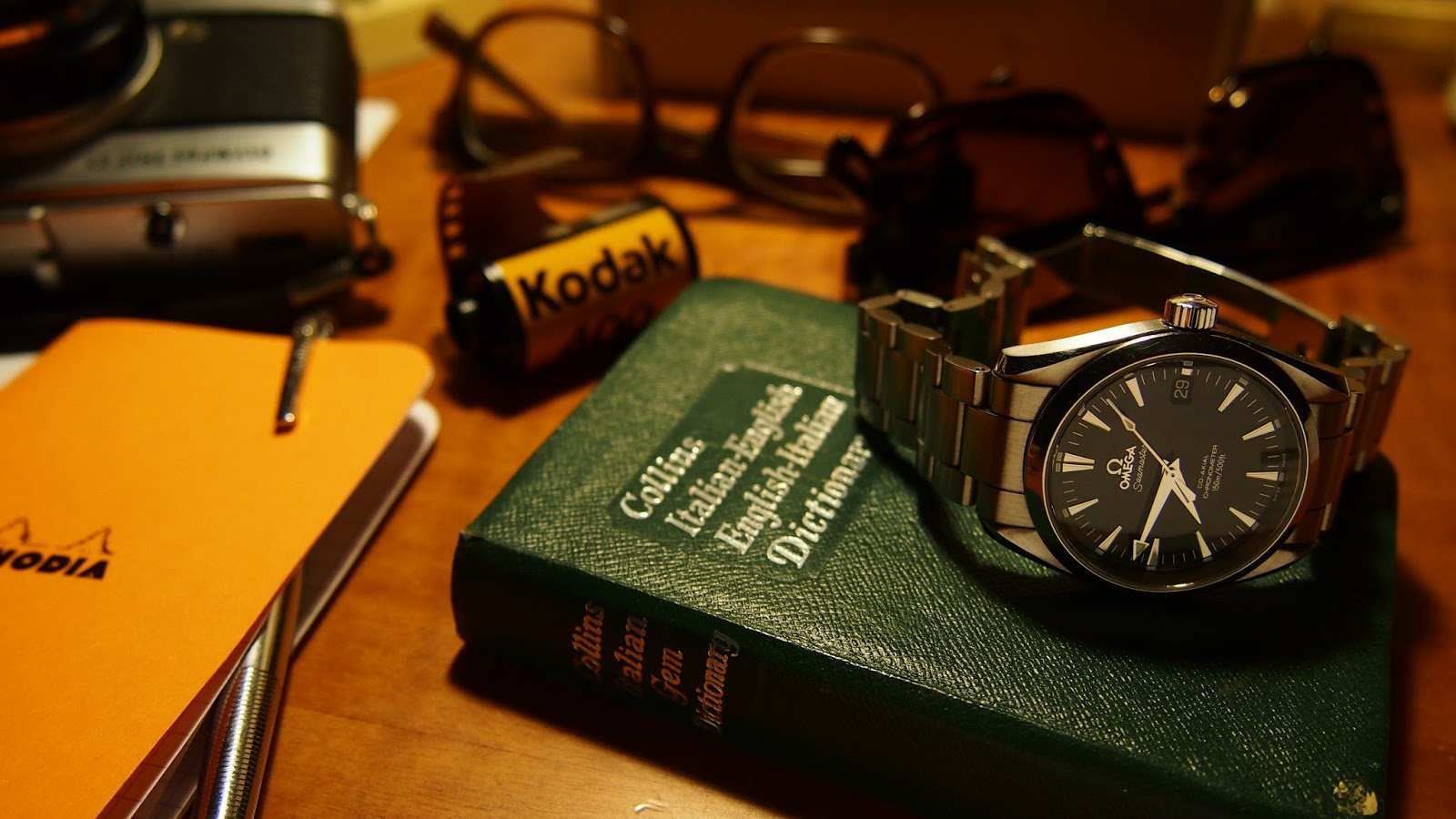
My regular readers (all four of you) may know that I worked at a wristwatch boutique from 2001 till 2012. This store sold twenty-one different Swiss brands, and Oris was one of them. When I started in the industry - briefly in late 1999 through to a few months into 2000 - I saw that many Swiss watchmaking houses were returning to production of mechanical wristwatches, produced alongside their quartz counterparts. By the time I got back into the industry eighteen months later, mechanical wristwatch production was becoming more widespread across the major brands.
The 1970s brought about what later became known as The Quartz Crisis, as cheap, battery-powered watches began to emerge from Japan. This had far-reaching and irreversible effects on the Swiss watch industry, as many smaller watchmaking brands went bust while others merged in an effort to remain in business. Other brands were later swallowed up by luxury brand juggernauts such as Richemont, The Swatch Group and LVMH, which stands for Louis Vuitton, Moet & Hennessy, to give you an indication of how many pies they have their fingers in.
Oris remained independent for the most part throughout this turbulent period and, while dabbling in production of quartz-powered watches in the 1980s (like almost everyone else), the brand returned to manufacture of mechanical watches in the early 1990s, earlier than many larger Swiss brands like Longines, TAG Heuer and Tissot, for example.
The Oris brand currently comprises of four main product ranges;
* Aviation, which carries a selection of pilot's watches and features their famous Big Crown model, which was first produced in 1938. It was christened the Big Crown because, that's right, it has a larger than normal winding crown to allow the watch to be set and wound while wearing flight gloves.
* Motor Sport features a collection of watches and chronographs with dials that look like they've been taken from a racing car's dashboard. Very modern case designs and numeral fonts give much of this range a Formula 1 look, and some of the models employ high-tech materials such as carbon fibre for the dials or cases in PVD-coated stainless steel.
* The Culture range is made up of dressier pieces, with both steel bracelet and leather strap options. This range provides a nice contrast to the rest of the Oris line-up and it is this collection that features watches with more complications (in watchmaking terms, this refers to other functions beyond mere time and date) such as triple-dates, moon-phase display, 24 hour time display, or 2nd time-zones.
 *And, last but not least, the Diving range, which is a staple of many Swiss brands. I have to hand it to Oris for producing something like the TT Diver back in the early Noughties (picture taken from www.timezone.com ).
While I found it a little too modern for my tastes, it was a serious (and successful) attempt at creating a dive watch that looked different to much of what other brands were producing at the time. The slim, low-profile case design was certainly an update on the traditional dive watch, and it offered thick lugs with a smooth curvature to them, allowing for a wonderful low-profile fit on the wrist. The winding crown and Helium valve were both large, making for easy use with wet hands, and the dial legibility, with its long shark-tooth hour markers and spear-shaped hands gave us a diver's watch that brought something new to the table. This dive watch was a steady seller in my store back in the day.
Since its release, the TT Diver has been given a few tweaks to keep it fresh and has, in recent years, evolved into the current series known as the Aquis.
 It's definitely a modern interpretation of classic dive watch
design, while still retaining all of the elements that are necessary in a
diver's watch;
It's definitely a modern interpretation of classic dive watch
design, while still retaining all of the elements that are necessary in a
diver's watch;
- Clear readability of the dial.
- An easy-to-grip rotating bezel.
- A clearly visible running indicator (that's the seconds hand).
- More water-resistance than you'll ever need.
_______________________________
Los Angeles, January 1964
I handed in my resignation on Friday. Re-wrote it a dozen times before I was satisfied with it. Warner wasn't happy, but he understood why. A couple of inches higher and that .38 round would've sliced my heart in two.

Instead, it just killed my wristwatch and put a hairline fracture across my ulna.
Anyway, I'll look for a new job once the arm heals. Maybe give Travis a call and see if I should put in an application at The Agency for their Summer intake.
But first, I need a new wristwatch.
______________________________________
Now, I've always considered Oris a very tricky brand. By this I mean, just when I think I've seen everything these guys have to offer, the company releases some new watch that makes me look twice. I have to hand it to Oris for being so creative with its designs so consistently.
This is not a brand that tends to rest on the reputation of a few models.
At the 2015 BaselWorld Watch and Jewellery Fair, Oris unveiled the Divers SixtyFive model, a conservatively-sized dive watch with a 100 metre water-resistance and a dial layout featuring a funky 1960s-era numeral font. It was a big hit, as wristwatch blogs lit up with praise for this watch.

At 40mm in diameter, it was something of a gamble on Oris' part. The big watch craze that commenced sometime around 2003 (as far as I'm concerned) showed no signs of letting up, and to release a dive watch in this smaller size was a bold move.
This piece was based on a 36mm dive watch from the Oris archives, a model that was first produced in 1965, hence the name of this new version.
The numeral font has perhaps been the most polarising aspect of this watch. Some folks love it, some folks don't.
Me?
Well, you'll just have to keep reading, won't you? Tell ya about it later on.

This watch was a great success for the brand. So much so,
that a 42mm version was released the following year. This one, though,
had a different dial configuration, opting for a more traditional
layout, once again based on a model from the Oris archives. Being a
larger case size, it soon became a strong seller, since it was more in
keeping with the larger-watch trend.
There were numerous other dial colours released throughout 2016. A Limited Edition model in a bronze case was produced to commemorate the life and achievements of Carl Brashear, the first African-American to become a Master Diver in the US Navy.

The bronze case was a nod to the materials used for old diving equipment. Bronze develops a patina over time and each of these 2,000 watches will age differently.
This very popular model sold out quickly. The dial was a deep glossy blue and it contrasted beautifully with the markers and hands.
To learn more about Carl Brashear himself, here's the link to the Wikipedia page;
Based on the success of this model, Oris unveiled a chronograph version at BaselWorld earlier this year, again celebrating the life of Carl Brashear. Like the first version, this new model has generated a lot of internet watch forum buzz.
Getting back to the Divers SixtyFive, I was tempted to go for the 42mm model, but something kept holding me back. It has a sleek vintage dive watch look to it and, while it may at first glance hold a few design cues lifted from a 1950s Rolex Submariner, the more you look at it, the more differences you actually begin to see.
The case design is different, opting for traditional squared-off edges rather than the beveled edges found on a Submariner.
The dial arrangement consists of framed dot hour markers, similar to the Sub and many other dive watches that appeared in the 1950s and '60s, but again, closer inspection shows that these markers sit slightly higher on the dial than the Sub, and the two markers at the 6 and 9 cardinal points are boxier than the narrower rectangles of the Submariner dial.
The picket-fence hands make for great legibility against the deep blue dial and with a design far removed from the Mercedes-and-spear hands of the Submariner.
The picket-fence hands make for great legibility against the deep blue dial and with a design far removed from the Mercedes-and-spear hands of the Submariner.
As I say, the more you look at this watch, the further it distances itself from the Sub, and I think Oris were well aware of this and the risks of producing a watch that could be viewed as copying the most famous dive watch in the world.
Although, put this Oris watch down in front of somebody who's into wristwatches and the differences are all too clear to see.For many watch collectors, the devil is in the details.
Yep, I was very tempted by this 42mm model, but there was just one thing stopping me from going for it - it was 42mm in diameter.
Now, you might be asking What's a millimetre or two between friends?
Well, having sold watches for so long, having seen customers try on a multitude of watches on a multitude of wrists, and having collected watches for 20 years, I'd become very sensitive to differences in case sizes and can really notice the one or two millimetre disparity when a watch is on my own wrist.
Not only that, but since I'd gotten myself a vintage Submariner 5513 a couple of years ago, I'd firmly adopted the view that I'd always suspected I had- basically, a 40mm dive watch is a more appropriate fit for my 6.5inch wrist. Besides, 40 mil gives a dive watch a more classic and vintage vibe.

And so, as much as I liked the look of the 42mm Divers SixtyFive, I decided to pass on it. I've made enough errors of judgment during my watch collecting life. I've bought watches that I shouldn't have, I've sold watches that I should have kept.
As such, I have a better understanding of myself as a watch collector and I just knew that had I gotten myself this 42mm model, it wouldn't get the wrist time that it deserves.
So, I took another look at the 40mm model, but I couldn't bring myself to get this one either. Reason being the black dial. I had enough dive watches with black dials. So, I held off and let it simmer on the back-burner of my mind for a while.
 Of course, Oris being Oris, it had a trick up its sleeve. Namely, this beauty on the right.
Oh. You. Sneaky. Bastards. They'd done it again. Once this model became available, I tried it on.
It was all downhill from there.
The Oris Divers SixtyFive 40mm
Model No: 01 733 7707 4035 - 07 8 20 18
THE PACKAGING
I don't place too much importance on the packaging of a wristwatch. Once you get the watch home from the store, the box ends up in some dark corner of a wardrobe, never to be seen again until you either get rid of the watch or your house burns down.
I prefer the box to be smallish and discreet, since I'll most likely not use it for any other purpose. Some brands used to have a removable insert so that you could re-purpose the box for something else, like putting it on your desk and filling it with unfiltered Camels or jelly beans.
These days, though, many brands have created boxes with fixed inserts that can't be removed, so you're left with a box that's only designed to hold the watch.
Which is handy if you decide to sell the watch one day.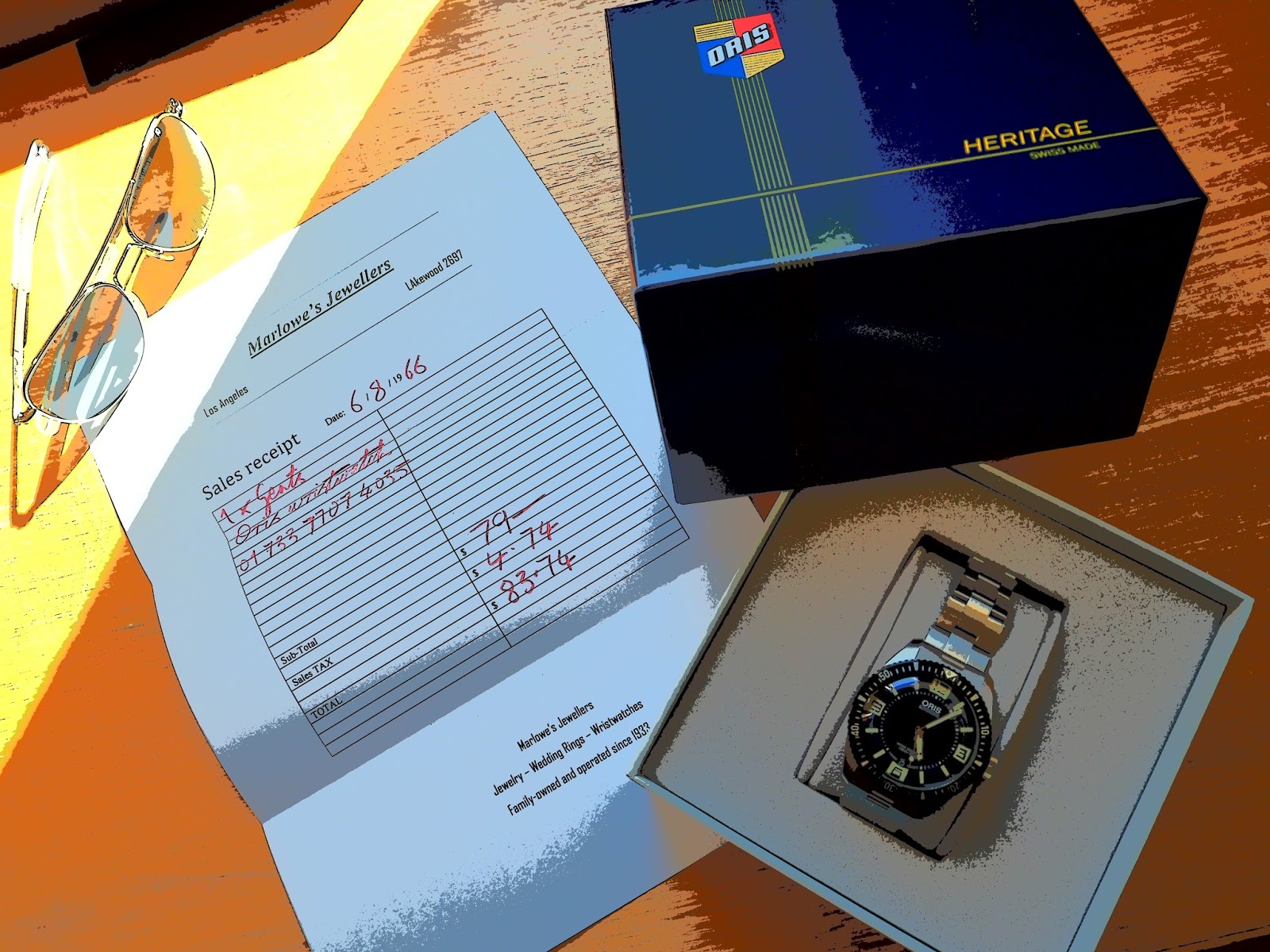
Saigon, May 1966
My wristwatch got smashed up in an alley in District 3. I'd had it for less than two years, for Pete's sake.
It was way past curfew. I was following a Viet Cong informer when two of his buddies appeared out of nowhere armed with a couple of switchblades. I had to fend 'em off with a garbage can lid and a broken Johnnie Walker bottle, looking like a cross between a Roman gladiator and a Hackensack barfly.
One of them gave up the fight pretty quick after I caressed his arm with the bottle. That sent him running.
His pal was a little more ambitious, slamming me hard against a wall. That's what did the wristwatch. Then he gave my arm a taste of his blade.
One of them gave up the fight pretty quick after I caressed his arm with the bottle. That sent him running.
His pal was a little more ambitious, slamming me hard against a wall. That's what did the wristwatch. Then he gave my arm a taste of his blade.
By that stage, I'd had enough and decided to overreact, using the bottle AND the lid on him. By the time I was done, the informer was long gone. I managed to get out of there and back to the safe-house without being spotted by any NVA troops.
At any rate, my cover was blown that night as far as Saigon was concerned. Station Chief Sheldrake had me on an Air America flight out of Bangkok next day.
I had the cut on my arm properly tended to when I got back Stateside and then went out and bought a new wristwatch. Compared to what I had, this watch does seem a little large. Sure feels sturdy, though. And it's not afraid of water. Probably a good thing. Nice and easy to read, too.
Wonder where I'm headed next?
______________________________________
The box is nice. In keeping with the vintage vibe of the watch, it's of a dark blue cardboard and features the old Oris logo of years gone by, with the words 'Heritage - Swiss Made' printed on it.
Inside is a slot with a cushion to clamp the watch around. This box goes into a slightly larger black cardboard box with contains a slot for the Owner's Manual and Warranty card. Nice and simple.
THE CASE
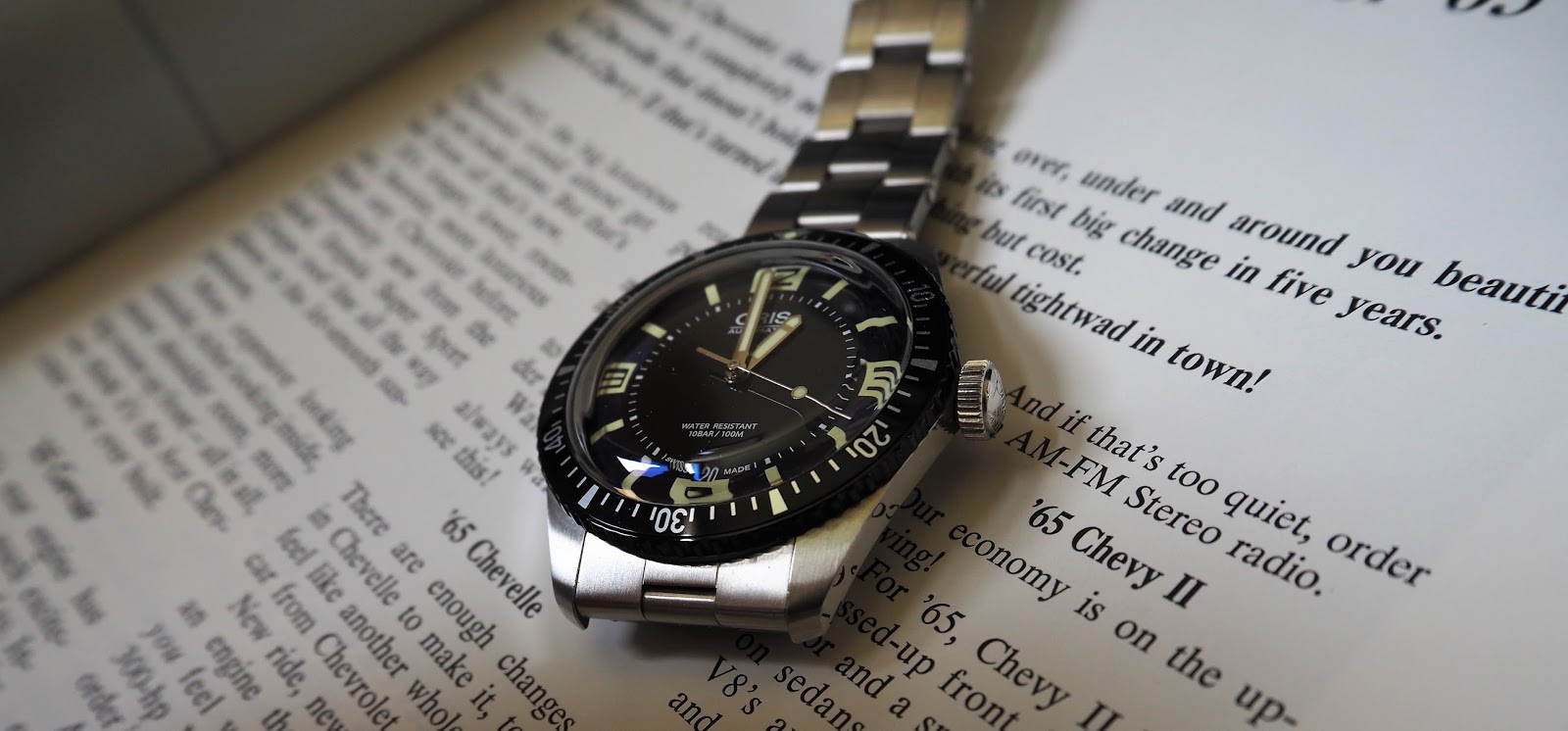
The case of the Divers SixtyFive is an exercise in simplicity. The lugs are angled, with a nice taper towards the bracelet. Viewed from the side, the lugs slope downward, making for a good fit. The 40mm diameter of the case goes against the current trend for larger watches, and Oris exercised restraint in not making this a 42mm or 44 mm watch.
As mentioned, the original watch on which this one is based measured 36mm, a common size for dive watches back in the 1960s (when scuba diving really began to take hold as a recreational sport), but the more well-known dive watches of the time were closer to 40mm in diameter. Choosing to release the Divers SixtyFive in 40mm was an inspired move.
Many brands have dipped into their archives in recent years to produce modern versions of older models. Oris have done this from time to time over the past decade, most notably with the Chronoris re-edition back in 2007, which was based on a model from 1970. Again, this re-issue was a larger size than the original, aimed at modern tastes.

At 40mil, this watch sits nicely on my 6.5 inch wrist, and with a case thickness of 12.8mm, it doesn't scream 'look at me!'
As a point of difference to the original model, and most other current dive watches from other brands, the rotating bezel is coated in glossy black PVD instead of being left in stainless steel. It’s a nice touch. The bezel insert is of black anodized aluminium, like dive watches of old. While we are now in an age of ceramic bezel inserts, I myself much prefer a simple aluminium bezel.

 THE HANDS
Just like the original model, the current one features plain picket-fence hands. These ones have a generous layer of SuperLuminova, making for easy legibility in the dark. The seconds hand has an easily seen lumed dot towards its outer third, further taking its cues from vintage dive watches.
THE DIAL
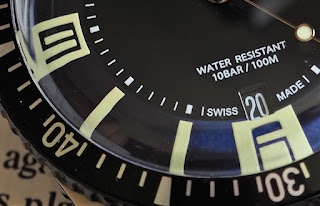 As mentioned earlier, perhaps the most polarising and talked-about feature of this watch's overall look was the dial, or rather, the numerals. I'll admit that it gave me pause. Did I like those kooky numbers? Would I get sick of them?
This alone was the most different visual element of this watch when compared to my other dive watches.
And then, the more I thought about it, the more I remembered certain things from my years as a watch collector and seller;
- When I first started in the watch industry, I spoke to the Breitling Sales Manager. We got to talking about certain models in the Breitling range and I mentioned the bezel design of the Blackbird, Crosswind and Aerospace models. (pic below courtesy of www.breitling.com )
At 40mil, this watch sits nicely on my 6.5 inch wrist, and with a case thickness of 12.8mm, it doesn't scream 'look at me!'
As a point of difference to the original model, and most other current dive watches from other brands, the rotating bezel is coated in glossy black PVD instead of being left in stainless steel. It’s a nice touch. The bezel insert is of black anodized aluminium, like dive watches of old. While we are now in an age of ceramic bezel inserts, I myself much prefer a simple aluminium bezel.

The crystal is domed sapphire. This was a virtual
impossibility about fifteen years ago, as it was extremely difficult to produce
a sapphire crystal in this shape. Back then, sapphire crystals were flat, mineral
or acrylic crystals were domed. Sapphire crystals were (and still are) almost impossible
to scratch, mineral and acrylic could scratch quite easily. Quick tutorial - mineral crystals are made of silica-based tempered glass. Acrylic crystals are made of plastic, as the name suggests. Sapphire crystals were developed sometime in the '90s, I think.
 I prefer the look of mineral or acrylic, but I like
the strength of sapphire. I like mineral and acrylic crystals for the way they distort the
printing on the dial depending on the viewing angle, and I like the old-school
look that they give the watch.
I prefer the look of mineral or acrylic, but I like
the strength of sapphire. I like mineral and acrylic crystals for the way they distort the
printing on the dial depending on the viewing angle, and I like the old-school
look that they give the watch.
So, I was happy to see modern watches come out in recent years with domed sapphires. On the SixtyFive, it works beautifully, and it still creates the distorting effect of mineral and acrylic crystals. Again, this adds to the vintage appeal of the Divers SixtyFive series.
The crown is a screw-down arrangement, with no 'shoulders' on either side of it. One could argue that shoulders - raised metal barriers on the side of the case, designed to offer some protection to the crown from glancing blows - would have been a wise addition to the case design, but I have yet to hear or read of a Divers SixtyFive's crown being knocked off the case due to impact.
_____________________
East Berlin, July 1966
Gunther Hoffmann was an upper-level cipher clerk working in the Stasi's Directorate of Cryptology. This gave him direct access to all manner of sensitive communications between East Berlin and Moscow.
Everything from how far the Reds had gotten with their space program, to placement of undercover KGB agents around the world. A virtual goldmine of information.
The Agency decided he'd be an asset worth having.
 Hoffmann would get to work at eight am sharp and work through till six pm each day. His half-hour lunch break was usually taken at a wooden bench in the Städtischer Friedhof cemetery. His wife had died of breast cancer a year ago, leaving him and their daughter behind. He'd been visiting her grave ever since.
One of our boys made initial contact with him at a cafe near his apartment, posing as a salesman from the Optima typewriter company. The place was full and our guy offered a seat to Hoffmann at his small round table one evening. They made occasional small talk while they both read the day's papers.
Our agent was good. He was very, very good. He spent the next four months 'bumping into' Hoffmann at the cafe until their small talk turned to the State and the way it was run. About the corruption, the black markets, the poor state of education and health care. It was then that Hoffmann began to open up about his views on life in East Berlin since the Wall went up in '61. That was our cue.
Our guy casually mentioned at their next 'chance meeting' that he knew somebody who knew somebody from The West. Somebody who could get Hoffmann out of the Communist grip.
That was enough to plant the seed in Hoffmann's head.
The Agency's plan was fast and loose. The idea was to fake Hoffmann's death, get him over to The States, and have him go through any intercepted transmissions that we got from East Berlin. As long as we could stage his death convincingly enough, the Stasi would have no reason to suspect anything, and so therefore, they wouldn't change any of the codes used in communications to Moscow. Under no circumstances was he to take any intelligence with him. We didn't want to arouse any suspicion whatsoever.

So, I was happy to see modern watches come out in recent years with domed sapphires. On the SixtyFive, it works beautifully, and it still creates the distorting effect of mineral and acrylic crystals. Again, this adds to the vintage appeal of the Divers SixtyFive series.
The crown is a screw-down arrangement, with no 'shoulders' on either side of it. One could argue that shoulders - raised metal barriers on the side of the case, designed to offer some protection to the crown from glancing blows - would have been a wise addition to the case design, but I have yet to hear or read of a Divers SixtyFive's crown being knocked off the case due to impact.
_____________________
East Berlin, July 1966
Gunther Hoffmann was an upper-level cipher clerk working in the Stasi's Directorate of Cryptology. This gave him direct access to all manner of sensitive communications between East Berlin and Moscow.
Everything from how far the Reds had gotten with their space program, to placement of undercover KGB agents around the world. A virtual goldmine of information.
The Agency decided he'd be an asset worth having.
 Hoffmann would get to work at eight am sharp and work through till six pm each day. His half-hour lunch break was usually taken at a wooden bench in the Städtischer Friedhof cemetery. His wife had died of breast cancer a year ago, leaving him and their daughter behind. He'd been visiting her grave ever since.
 One of our boys made initial contact with him at a cafe near his apartment, posing as a salesman from the Optima typewriter company. The place was full and our guy offered a seat to Hoffmann at his small round table one evening. They made occasional small talk while they both read the day's papers.
Our agent was good. He was very, very good. He spent the next four months 'bumping into' Hoffmann at the cafe until their small talk turned to the State and the way it was run. About the corruption, the black markets, the poor state of education and health care. It was then that Hoffmann began to open up about his views on life in East Berlin since the Wall went up in '61. That was our cue.
Our guy casually mentioned at their next 'chance meeting' that he knew somebody who knew somebody from The West. Somebody who could get Hoffmann out of the Communist grip.
That was enough to plant the seed in Hoffmann's head.
The Agency's plan was fast and loose. The idea was to fake Hoffmann's death, get him over to The States, and have him go through any intercepted transmissions that we got from East Berlin. As long as we could stage his death convincingly enough, the Stasi would have no reason to suspect anything, and so therefore, they wouldn't change any of the codes used in communications to Moscow. Under no circumstances was he to take any intelligence with him. We didn't want to arouse any suspicion whatsoever.
That's where Carson and I came in. I was to use my charm, but Carson wanted to be a little more persuasive. I'd never worked with the fella before, but I'd heard about him. Ex-Marine sharpshooter back in Korea during the War, before transferring to Army Intelligence afterwards. Ten years of that and then he joined the CIA. He represented everything that was wrong with the Agency today, but he was known to get the job done. By any means necessary.
Although, since Hoffmann was my asset, I had operational control. But he wasn't gonna make a move unless his daughter came along too, even though they'd become estranged since Frau Hoffmann had died. Problem was, she didn't want to leave Berlin, no matter how bleak it was. She was enjoying her studies, and had friends here, he told me.
We'd be meeting with him at ten o'clock tonight in this shabby little hotel room, to try and dangle another carrot in front of him. Reassure him that we could get him and his daughter safely to the US.
Carson drank the last of the coffee and finished all my cigarettes after burning through his own pack of French nails. He'd spent two months working out of the Paris desk last year. Now he thinks he's Jean-Paul Belmondo.
Carson drank the last of the coffee and finished all my cigarettes after burning through his own pack of French nails. He'd spent two months working out of the Paris desk last year. Now he thinks he's Jean-Paul Belmondo.
Twenty minutes later, he was stepping out to go buy some more. Said he knew a black marketeer who had the last three cartons of Gitanes left in East Berlin. Said he could even get me Marlboros for three US dollars a pack. More than ten times what I'd pay for them back home, for cryin' out loud!
I gave him six bucks.
Life was expensive this side of Checkpoint Charlie.
I gave him six bucks.
Life was expensive this side of Checkpoint Charlie.
"Get some more coffee while you're at it", I said. Told him not to hurry, either.
That way, I might get a chance to finish the book I was reading.
And I'd also have a break from Carson. I really didn't like the guy.
Can you tell?
___________________________
The crown screws down securely, giving the watch its 100 metres of water-resistance. Your diving purists would argue that 100m does not make for a true dive watch, but this depth rating is more than adequate for recreational diving where you are likely to only go down as deep as 30 or 40 metres.
There are no protective 'shoulders' on either side of it, in keeping with vintage watch design. This should pose no problem. If you are as reasonably careful with this watch as you would be with any other watch with no crown guards, you will have no issues.
The crown screws down securely, giving the watch its 100 metres of water-resistance. Your diving purists would argue that 100m does not make for a true dive watch, but this depth rating is more than adequate for recreational diving where you are likely to only go down as deep as 30 or 40 metres.
There are no protective 'shoulders' on either side of it, in keeping with vintage watch design. This should pose no problem. If you are as reasonably careful with this watch as you would be with any other watch with no crown guards, you will have no issues.
 THE HANDS
Just like the original model, the current one features plain picket-fence hands. These ones have a generous layer of SuperLuminova, making for easy legibility in the dark. The seconds hand has an easily seen lumed dot towards its outer third, further taking its cues from vintage dive watches.
THE DIAL

This alone was the most different visual element of this watch when compared to my other dive watches.
And then, the more I thought about it, the more I remembered certain things from my years as a watch collector and seller;
- When I first started in the watch industry, I spoke to the Breitling Sales Manager. We got to talking about certain models in the Breitling range and I mentioned the bezel design of the Blackbird, Crosswind and Aerospace models. (pic below courtesy of www.breitling.com )

"We designed the bezels this way so that somebody who knows about wristwatches would see one of our watches on someone's wrist from across the room and instantly recognise it as a Breitling", he added.
I knew exactly where he was coming from. Placing distinctive markers on those four points does make a watch stand out.
That conversation took place back in 1999, and Breitling still use these four markers on the bezels of many watches in their current line-up.
It has indeed become a trademark of theirs, making a Breitling watch instantly recognisable.
 - I also remembered that there are a number of other brands that use distinctive markers on the dial at those four compass points. The Eterna Kontiki models, for example have also employed this dial configuration. Both the 1960s version (on the left) and the current iteration (right) share the same DNA and the mere highlighting of these four numbers on the dial makes for an eye-catching design.
This was quite a popular look for many dive watches of the era, as I saw the 12, 3, 6 and 9 numerals highlighted on many vintage dive watches during my late night trawls across eBay and other dealer sites.
________________________
East Berlin, mid Sept 1966
 Her
name was Ursula. She was 19 years old. Was doing well at the State University. Wanted to
be a nurse. Had a steady boyfriend, a nice young man that her father
approved of. All of that was blown to hell now.
Her
name was Ursula. She was 19 years old. Was doing well at the State University. Wanted to
be a nurse. Had a steady boyfriend, a nice young man that her father
approved of. All of that was blown to hell now. One bullet made sure of that.
It was the landlady, Trude, who discovered the body. She used her master-key to let herself in to Ursula's rooms after knocking on the front door a few times and getting no reply. Found the girl and called me. I gave Trude my number months ago. Most of her family was in West Berlin, so she fully knew where I was coming from and what I did for a living.
Don't know why I checked for a pulse. Her skin was ice cold. Single shot through the half-open window. Caught her in the chest, right through the heart, while she sat there painting her nails. She landed face-up on the bed. Would've been instant. I hope so.
Now I had to call Hoffman. To tell him his daughter was dead.
_______________________________________________________
 The more I thought about it, the more I began to appreciate the dial layout. The numeral font bugged me for about a week, until it hit me - all of a sudden one night while casually glancing at the time - that this font was perfectly in keeping with 1960s typographic style and these numbers have a slight 'Sixties sci-fi' look to them.
Once I made that realisation, I began to like them more and more.
And, when compared to the mid-Sixties original model, in this photo courtesy of www.timeandtidewatches.com...

On the original model (left) you can see that the number 3 has been 'bitten into' by the date window, slightly upsetting the balance of the rest of the dial.
This modern iteration is truly a watch that looks like it was pulled from a time capsule.
Each of the four numerals is ever-so-slightly trapezoid and they sit in a large square of faux-aged SuperLuminova. The rest of the hour markers are also luminous. It actually took me about four or five months to realise that the lume was done using a pale greenish hue, rather than Oris opting for the standard white.

Regarding the dial of this new Divers SixtyFive, it was the subtle mix of black and blue that really pushed me over the edge. It starts off as a black disc from the middle going out three quarters of the way towards the edge where it is surrounded by the minute track. This in itself is a nice touch, as it further differentiates this Oris from many dive watches on the market. The minutes are not situated on the outer edge of the dial.

In low light, the entire dial looks black. Take the watch into bright natural light and the outer edge lifts into the blue ring. Put on a pair of sunglasses and look at the dial and the blue takes on a purple tinge.
It's almost like having three watches in one.
___________________________
East Berlin, mid November 1966
The newspapers had reported it as a random act, while the East German authorities promised 'a thorough investigation and swift justice.'

Hoffmann ceased communications with us after she was killed. Blamed me for it when I broke the news of her death to him. We thought it might have been the Stasi's way of putting out a warning to all concerned. It seemed to be their style.
However, based on our intelligence, Hoffmann was still working in the Directorate. He was given a week's compassionate leave, to arrange and attend her funeral.
I kept trying to get hold of him, with no luck. Our man, the fella posing as the typewriter salesman, caught up with him at the cafe one morning. Hoffman invited him back to his apartment for dinner later that week.
It was there that our agent, code-named 'Plier', got him talking after a few glasses of vodka from a bottle he'd brought as a gift. Hoffman spilled his guts, telling him about our attempts to lure him to the West. Acting as 'a concerned friend', Plier managed to convince Hoffmann to get in touch with me, telling him that 'a fresh start in a new place' might be the best thing for him.
Another month passed before Hoffmann called me on my secure line. It was a short conversation where I arranged to meet him at the safe house one last time. He would either come over to our side or he would not. I knew I'd have to practically beg him to believe that my organization had nothing to do with Ursula's murder.
In the meantime, I visited Trude at the boarding house, to thank her for her assistance. As I left the building afterwards, I looked down at the gutter and found a crumpled Gitanes pack poking out from under the wheel of a Beetle.
'Couldn't be', I thought to myself. Carson had returned Stateside after our meeting with Hoffmann at the safe-house in July.
__________________________________________
THE BRACELETAnother month passed before Hoffmann called me on my secure line. It was a short conversation where I arranged to meet him at the safe house one last time. He would either come over to our side or he would not. I knew I'd have to practically beg him to believe that my organization had nothing to do with Ursula's murder.
In the meantime, I visited Trude at the boarding house, to thank her for her assistance. As I left the building afterwards, I looked down at the gutter and found a crumpled Gitanes pack poking out from under the wheel of a Beetle.
'Couldn't be', I thought to myself. Carson had returned Stateside after our meeting with Hoffmann at the safe-house in July.
__________________________________________
The bracelet. Ahh, the bracelet. When looking at the watch itself, there was no other bracelet design that was going to work with this watch. It's a classic, three-link arrangement, similar to what was found on Submariner dive watches of the 1950s, complete with a faux-riveted edge. Now, one could argue that this design was heavily borrowed from Rolex, but the rest of the watch is so far removed from the Submariner design that I, for one, can forgive the bracelet similarity. Besides, the three-link design was adopted by so many other brands back then, and it's also a strong bracelet due to its composition. Three links across make for a solid bracelet. The fewer the links, the less that can go wrong. Less stretch, less twist. At least, that's what I noticed over the years in the watch game.

The whole bracelet has a matte finish, which tends to hide scuffs and scratches a little better than a polished finish.
The rivets on the side of the links are non-removable. Removable links are further down, closer to the clasp. It's a simple pin-and-tube arrangement, held together by friction. Each link has a hole drilled through it. The central link has a small tube in it. A long pin is pushed into the link from the outer edge and is tapped into this central link tube. The tube has a slight crimp in it and this holds the pin in place.
This is a basic, tried & tested link design and is used by a lot of brands. It's strong enough for daily use and it helps to keep the cost down. Pins and tubes can easily be replaced if/when they wear out.

The whole bracelet has a matte finish, which tends to hide scuffs and scratches a little better than a polished finish.
The rivets on the side of the links are non-removable. Removable links are further down, closer to the clasp. It's a simple pin-and-tube arrangement, held together by friction. Each link has a hole drilled through it. The central link has a small tube in it. A long pin is pushed into the link from the outer edge and is tapped into this central link tube. The tube has a slight crimp in it and this holds the pin in place.
This is a basic, tried & tested link design and is used by a lot of brands. It's strong enough for daily use and it helps to keep the cost down. Pins and tubes can easily be replaced if/when they wear out.
THE MOVEMENT
The Divers SixtyFive houses a Sellita Calibre SW-200 automatic movement. I won't go into too much detail about watch movements. There are numerous websites that offer better information than I could supply. The Swatch Group is the major player in the recent history regarding Swiss watch movements. At the turn of the century, The Swatch Group was supplying movements to a vast majority of Swiss watch brands.
Basically, The Swatch Group owns ETA, the largest Swiss watch movement manufacturing company. In 2003, Swatch Group CEO Nicolas G. Hayek announced that his company would cease supplying watch movements to watch companies outside of the Swatch Group. This would not happen overnight, but was designed to be a gradual trickling down of supply that would be cut off completely by 2011.
It was a complicated process, nicely explained on the third page of this article from www.ablogtowatch.com;
This left the rest of the Swiss watch industry with a couple of choices; go back to in-house production of watch movements or source movements from other manufacturers.
Sellita was a watch movement and component manufacturer that was already supplying parts to The Swatch Group for its movements, so this company was already well-versed in the technical aspects of The Swatch Group's movements. Since the patents for many ETA movements had expired some time ago, Sellita was able to reproduce these movements for use by watch brands outside of The Swatch Group umbrella.
Oris is one of the brands currently using Sellita movements. However, the brand produced its own in-house hand-wound Calibre 110 in 2014, to mark the 110th Anniversary of the Oris brand.

It takes a lot of R & D to come up with a new watch movement and this one caused a lot of watch geeks to sit up and take notice when it was released. It features a ten-day power reserve with an indicator on the dial. Fully wound, this watch will run for ten days and the dial shows how much power is stored in the mainspring. Think of it as similar to a fuel gauge on the dashboard of a car.
Oris has since gone on to add the Calibres 111, 112 and 113 to its collection, each with differing functions. No mean feat when you consider that other brands offer similar power reserves with some of their watches, but charge almost double the price of the Oris equivalents.
The Divers SixtyFive contains a Calibre 733, a modified Sellita SW200 calibre. It's an automatic movement with a 38 hour power reserve and hacking seconds - which means you can stop the watch ticking, to synchronise the seconds hand, like a RAF pilot before a mission over Normandy.
 It's dependable, easy to work on, and offers a central seconds hand and date complication. It's a basic workhorse watch movement. As such, it is used by a myriad number of watch brands. Also, with a little tweaking, you can get Chronometer-level timekeeping out of this movement.
What's not to love?
As with almost all Oris movements, the rotor is given an anodised coating in red and this has become a signature of the brand over the last fifteen years or so.
The dive watch is a staple of most watch brands. Their sales and manufacture began to climb back in the late 1950s/early 1960s as scuba diving grew in popularity.
Having amassed a varied collection of watches over the last 20 or so years, I realised that, as far as sports watches go, I prefer a dive watch over any other type of watch with a secondary purpose. These kinds of timepieces (hated phrase) are known as 'tool watches'. Basically, they're designed to provide another function beyond mere time and date. That's my take on what a tool watch is. Another definition explains them as being for a specific purpose or to help perform a certain task. For example, chronographs offer a stopwatch function, GMT or world-timers allow you to set the watch for two or more time-zones.
Even though I have two chronographs, I rarely find myself having to time anything of great importance. As for a GMT watch, while it would be nifty to have one (and I just might one day), I really don't travel enough to warrant having one.
A dive watch, though, I can easily justify, despite the fact that I don't dive. For me, the appeal of this kind of watch lies in its sharp legibility. A well done dive watch displays the time with no margin for error. Its readability is its greatest strength, as far as I'm concerned.
That's the visual appeal. Function-wise, aside from telling the time, the rotating bezel comes in handier on dry land than you think. Set the bezel marker against the minute hand and you can count down a lunch break, a hard-boiled egg, or a parking meter at a glance.
Also handy is the water-resistance. The Divers SixtyFive is rated down to 100 meters, more than enough for recreational dives. For mere mortals like myself on a day-to-day basis, this watch is water-protected against splashes at the kitchen sink, reaching into a bucket of water, days at the beach, and also an occasional shower, provided the crown is screwed down properly and the rubber seals are doing what they should.
For me, this is the appeal of a dive watch on a practical and aesthetic level.
Although, beyond that, a dive watch holds a greater allure for me in terms of what it represents on a sub-conscious level.
I associate dive watches with scuba diving, for one thing. Even though, as I say, I don't dive or ever have. This in turn ties in with the worlds of deep sea exploration, ancient sunken treasures, National Geographic articles and photo-shoots.
I also associate them with James Bond, having seen my first Bond movie as an impressionable kid back in the mid '70s. Certainly, his Submariner has it's place in cinematic 007 lore, but he's also worn Omega Seamaster dive watches on-screen for almost 25 years now.
In short, a dive watch represented the type of watch that a man of action would wear, whether he was a fictional British super-spy, famed French oceanographer Jacques-Yves Cousteau, an '80s Formula 1 driver, or actor Steve McQueen.
_____________________________
West Berlin, Christmas Eve, 1966
We got Hoffmann into West Berlin a week ago, in the hidden compartment of a refrigerated meat transport van, with 'Schneider Butchers' painted across its sides. He was shaking like a leaf by the time we got him out of there. I poured him a hot and strong black coffee from a thermos I'd brought along before he was taken to Federal Intelligence Service headquarters (the Bundesnachrichtendienst, or BND for short) and given a physical. He was then debriefed by his new handlers.
He stayed hidden in West Berlin for a week or so before boarding a C-130 at Ramstein Air Force Base which would take him to the US. Langley would be his next stop after that, where he'd be welcomed with open arms. My job here was done. Two days from now, I'd be back Stateside. Just in time for New Year.
Meanwhile the BND got to work. Agents stationed in East Berlin took Hoffman's Trabant P50 from outside his apartment one night. That same evening, the Schneider Butchers truck crossed over into East Berlin via Checkpoint Charlie. With the body of a 55 year-old hobo in the hidden compartment. He'd died in Spandau of pneumonia. Police found him slumped over on a park bench the day before. It had been a particularly cold winter. He was a few years older than Hoffmann, but of similar build. A BND agent was made up to look like Hoffmann, with a wig of greying hair and tortoise-shell glasses. The hobo's body was loaded into the trunk of the Trabant. Along with a can of gasoline. The agent drove out to the Stadtforst. It would all go to hell if he was stopped by police.
The body was burnt beyond recognition, making a positive identification impossible. The Stasi listed it as a suicide. Perfectly understandable given the recent events in Hoffmann's life. His desk was cleaned out and another staffer took his place at the Directorate.
The hobo was buried in East Berlin, under the name of Gunther Hoffmann, while over in a small church cemetery in West Berlin, the BND spent the necessary money for a casket. And a tombstone with his real name, Otto Kreisler, chiselled onto it. The grave, of course was empty. He had no next-of kin. Well, none that came forth.
I was packing my bag on my last night in Berlin, at the motel that I'd called home for the last six months, when there was a knock at my door. It was Carson, with a bottle of Old Grand-Dad. No doubt procured from his black marketeer.
"A night-cap, to say bon voyage", he said, as he headed for the kitchenette to fetch a couple of glasses. "And a Happy New Year", he added after he poured us a couple. I still didn't like him.
A little time passed and we made small talk as he poured me a second drink - it was free, after all - I opened the desk drawer, fished out the crumpled Gitanes pack and tossed it on the bed.
Carson stared at it a long time.
"Found it near his daughter's rooming house", I said.
He took his time to answer. "He needed a push. A reason not to stay. So we gave him one." He took a long pull of his bourbon.
"I get back to Langley, I'm reporting you. I already checked. HQ didn't sanction this. You're done for."
"Take it easy, Ritts. We got the outcome we wanted, what do you care? Like I say, he needed a push. Here, have another drink. Relax", he drawled as he reached for the bourbon.
"We got the outcome you wanted. You're through, Carson", I replied, resisting the urge to slam my knuckles through his face.
Carson took the bottle by the neck and in one swift move, swung it toward my head. It clocked me on the left temple and sent me reeling across the room. I felt a vise instantly tighten across my skull as I fell and my face and hands went cold. I heard quickened footsteps on broken glass. Carson wasn't gonna stick around to get me an ice-pack.
 It wasn't a hard enough blow to knock me cold, but it hurt like hell just the same. I shook my head quickly to clear it (didn't work), touched my throbbing temple and felt some swelling already. I looked at my fingers. There was blood on them.
The door to my room was wide open and I heard the staccato sound of steps on the stairs. I got up off the floor, staggered over to the door and shook my head a few more times. Bourbon flicked across the wall from my hair. Then I went after him.
I stumbled down to street level and looked left and right. Carson was about a hundred yards away. He made a dash into an alley. I got there in time to see him clamber over a wooden fence half-way down. So much for dead-ends. I reached it about ten seconds later and hauled myself over it, cursing the fact that I didn't grab the Colt from my motel room.
I landed on my feet in time to see him exit the other end of the alley and run across the road.
He got almost half-way before he was struck by a large white van.
With the name 'Schneider Butchers' painted across its sides.
'Merry Christmas, Carson', I thought to myself as I slowly approached the alleyway exit trying to catch my breath.
Before I passed out.
________________________________________
Anything else, Teeritz?
Okay, since you're asking.
As with almost all Oris movements, the rotor is given an anodised coating in red and this has become a signature of the brand over the last fifteen years or so.
The dive watch is a staple of most watch brands. Their sales and manufacture began to climb back in the late 1950s/early 1960s as scuba diving grew in popularity.
Having amassed a varied collection of watches over the last 20 or so years, I realised that, as far as sports watches go, I prefer a dive watch over any other type of watch with a secondary purpose. These kinds of timepieces (hated phrase) are known as 'tool watches'. Basically, they're designed to provide another function beyond mere time and date. That's my take on what a tool watch is. Another definition explains them as being for a specific purpose or to help perform a certain task. For example, chronographs offer a stopwatch function, GMT or world-timers allow you to set the watch for two or more time-zones.
Even though I have two chronographs, I rarely find myself having to time anything of great importance. As for a GMT watch, while it would be nifty to have one (and I just might one day), I really don't travel enough to warrant having one.
A dive watch, though, I can easily justify, despite the fact that I don't dive. For me, the appeal of this kind of watch lies in its sharp legibility. A well done dive watch displays the time with no margin for error. Its readability is its greatest strength, as far as I'm concerned.
That's the visual appeal. Function-wise, aside from telling the time, the rotating bezel comes in handier on dry land than you think. Set the bezel marker against the minute hand and you can count down a lunch break, a hard-boiled egg, or a parking meter at a glance.
Also handy is the water-resistance. The Divers SixtyFive is rated down to 100 meters, more than enough for recreational dives. For mere mortals like myself on a day-to-day basis, this watch is water-protected against splashes at the kitchen sink, reaching into a bucket of water, days at the beach, and also an occasional shower, provided the crown is screwed down properly and the rubber seals are doing what they should.
For me, this is the appeal of a dive watch on a practical and aesthetic level.
Although, beyond that, a dive watch holds a greater allure for me in terms of what it represents on a sub-conscious level.
I associate dive watches with scuba diving, for one thing. Even though, as I say, I don't dive or ever have. This in turn ties in with the worlds of deep sea exploration, ancient sunken treasures, National Geographic articles and photo-shoots.
I also associate them with James Bond, having seen my first Bond movie as an impressionable kid back in the mid '70s. Certainly, his Submariner has it's place in cinematic 007 lore, but he's also worn Omega Seamaster dive watches on-screen for almost 25 years now.
In short, a dive watch represented the type of watch that a man of action would wear, whether he was a fictional British super-spy, famed French oceanographer Jacques-Yves Cousteau, an '80s Formula 1 driver, or actor Steve McQueen.
_____________________________
West Berlin, Christmas Eve, 1966
We got Hoffmann into West Berlin a week ago, in the hidden compartment of a refrigerated meat transport van, with 'Schneider Butchers' painted across its sides. He was shaking like a leaf by the time we got him out of there. I poured him a hot and strong black coffee from a thermos I'd brought along before he was taken to Federal Intelligence Service headquarters (the Bundesnachrichtendienst, or BND for short) and given a physical. He was then debriefed by his new handlers.
He stayed hidden in West Berlin for a week or so before boarding a C-130 at Ramstein Air Force Base which would take him to the US. Langley would be his next stop after that, where he'd be welcomed with open arms. My job here was done. Two days from now, I'd be back Stateside. Just in time for New Year.
Meanwhile the BND got to work. Agents stationed in East Berlin took Hoffman's Trabant P50 from outside his apartment one night. That same evening, the Schneider Butchers truck crossed over into East Berlin via Checkpoint Charlie. With the body of a 55 year-old hobo in the hidden compartment. He'd died in Spandau of pneumonia. Police found him slumped over on a park bench the day before. It had been a particularly cold winter. He was a few years older than Hoffmann, but of similar build. A BND agent was made up to look like Hoffmann, with a wig of greying hair and tortoise-shell glasses. The hobo's body was loaded into the trunk of the Trabant. Along with a can of gasoline. The agent drove out to the Stadtforst. It would all go to hell if he was stopped by police.
The body was burnt beyond recognition, making a positive identification impossible. The Stasi listed it as a suicide. Perfectly understandable given the recent events in Hoffmann's life. His desk was cleaned out and another staffer took his place at the Directorate.
The hobo was buried in East Berlin, under the name of Gunther Hoffmann, while over in a small church cemetery in West Berlin, the BND spent the necessary money for a casket. And a tombstone with his real name, Otto Kreisler, chiselled onto it. The grave, of course was empty. He had no next-of kin. Well, none that came forth.
I was packing my bag on my last night in Berlin, at the motel that I'd called home for the last six months, when there was a knock at my door. It was Carson, with a bottle of Old Grand-Dad. No doubt procured from his black marketeer.
"A night-cap, to say bon voyage", he said, as he headed for the kitchenette to fetch a couple of glasses. "And a Happy New Year", he added after he poured us a couple. I still didn't like him.
A little time passed and we made small talk as he poured me a second drink - it was free, after all - I opened the desk drawer, fished out the crumpled Gitanes pack and tossed it on the bed.
Carson stared at it a long time.
"Found it near his daughter's rooming house", I said.
He took his time to answer. "He needed a push. A reason not to stay. So we gave him one." He took a long pull of his bourbon.
"I get back to Langley, I'm reporting you. I already checked. HQ didn't sanction this. You're done for."
"Take it easy, Ritts. We got the outcome we wanted, what do you care? Like I say, he needed a push. Here, have another drink. Relax", he drawled as he reached for the bourbon.
"We got the outcome you wanted. You're through, Carson", I replied, resisting the urge to slam my knuckles through his face.
Carson took the bottle by the neck and in one swift move, swung it toward my head. It clocked me on the left temple and sent me reeling across the room. I felt a vise instantly tighten across my skull as I fell and my face and hands went cold. I heard quickened footsteps on broken glass. Carson wasn't gonna stick around to get me an ice-pack.

The door to my room was wide open and I heard the staccato sound of steps on the stairs. I got up off the floor, staggered over to the door and shook my head a few more times. Bourbon flicked across the wall from my hair. Then I went after him.
I stumbled down to street level and looked left and right. Carson was about a hundred yards away. He made a dash into an alley. I got there in time to see him clamber over a wooden fence half-way down. So much for dead-ends. I reached it about ten seconds later and hauled myself over it, cursing the fact that I didn't grab the Colt from my motel room.
I landed on my feet in time to see him exit the other end of the alley and run across the road.
He got almost half-way before he was struck by a large white van.
With the name 'Schneider Butchers' painted across its sides.
'Merry Christmas, Carson', I thought to myself as I slowly approached the alleyway exit trying to catch my breath.
Before I passed out.
________________________________________
Anything else, Teeritz?
Okay, since you're asking.
The Divers SixtyFive occupies a nice place among today's dive watches, as far as I'm concerned. Oris did a great job in delving into its past to create a modern dive watch that incorporates elements from the previous model.
The case offers a sleek profile that will slide under a shirt cuff for the office, while also offering a robust sports watch that can handle the pool or the beach with ease.
The dial, love it or hate it, is like no other dive watch on the market, offering clear readability and beautiful contrast. This two-tone dialed model brings a nice point of difference to the table, helping to further distance this model from the stable of black-dialed dive watches on the market from other brands. The '60s-font numerals at the cardinal points of the dial are an added bonus. Your views may vary.
This is the kind of watch that will appeal to somebody who wants something a little different to the traditional dive watch dial configuration.
It might also appeal to somebody who already has a few dive watches and is after something just that little bit different to the rest of their collection.
I got mine in November 2016 and it very quickly became the wristwatch that I wore most often throughout 2017. The bracelet has a nice worn-in look to it now. Small scuffs here and there. The watch is now truly mine. Every scratch makes it more personal, more unique to oneself.
Surprisingly, this watch works very well on a black or blue NATO strap. Oris itself offers a dark blue NATO strap with a thin black stripe running down the length of it. Although, I love the bracelet on this watch and I tend not to switch things around.
______________________________
Paris, January 4th, 1967
Needless to say, I didn’t get out of Berlin on Christmas Eve. Carson and I were rushed to Charité Univesitätsmedizin (the university hospital). He was in much worse shape than I was, but the way my head felt, I’d argue that was debatable.
 It was a six-minute ride at breakneck speed. Didn’t
make a difference, though. Carson was pronounced dead on arrival to the Emergency
Room.
It was a six-minute ride at breakneck speed. Didn’t
make a difference, though. Carson was pronounced dead on arrival to the Emergency
Room.
While the Divers SixtyFive was perhaps aimed at the recreational dive watch market, the truth is that your average customer was more likely to wear their dive watch sitting at a desk rather than at the helm of a Zodiac inflatable. At least,that's what I noticed over the decade of selling watches.
Dive watches were, and still are, a popular type of wristwatch.
Which is why I chose the Cold War angle for the narrative vignettes in this review. To me, it seemed to fit perfectly, since I've always considered the dive watch to be a great, all-purpose kind of wristwatch for daily wear. Robust, clearly legible in any light, and with a handy rotating bezel.
There are a myriad number of dive watches on the market today. Virtually every brand offers one. However, the Oris Divers SixtyFive is a true stand-out.
In or out of the water.
Thanks for reading!
*******************
CREDITS
- Thanks again to wikipedia.com for the info regarding East and West Berlin during the Cold War and Saigon during the Vietnam War.
Any errors and inaccuracies regarding the facts are my own. As usual.
And once again, all my cutting and pasting from Word has resulted in a variety of fonts. Ahh, well...
Thanks to my daughter for posing as a hand model in one of the story photos.
Thanks to my son for helping with a couple of photos.
Thanks to my wife for putting up with me.
Story photos copyright, Teeritz, 2018.
Story photos taken with an Olympus Pen-F on Key Line Art Filter setting.
PLEASE NOTE: Some of the creative snippets were edited on April 24th, 2020.
The case offers a sleek profile that will slide under a shirt cuff for the office, while also offering a robust sports watch that can handle the pool or the beach with ease.
The dial, love it or hate it, is like no other dive watch on the market, offering clear readability and beautiful contrast. This two-tone dialed model brings a nice point of difference to the table, helping to further distance this model from the stable of black-dialed dive watches on the market from other brands. The '60s-font numerals at the cardinal points of the dial are an added bonus. Your views may vary.
This is the kind of watch that will appeal to somebody who wants something a little different to the traditional dive watch dial configuration.
I got mine in November 2016 and it very quickly became the wristwatch that I wore most often throughout 2017. The bracelet has a nice worn-in look to it now. Small scuffs here and there. The watch is now truly mine. Every scratch makes it more personal, more unique to oneself.
Surprisingly, this watch works very well on a black or blue NATO strap. Oris itself offers a dark blue NATO strap with a thin black stripe running down the length of it. Although, I love the bracelet on this watch and I tend not to switch things around.
______________________________
Paris, January 4th, 1967
Needless to say, I didn’t get out of Berlin on Christmas Eve. Carson and I were rushed to Charité Univesitätsmedizin (the university hospital). He was in much worse shape than I was, but the way my head felt, I’d argue that was debatable.
 It was a six-minute ride at breakneck speed. Didn’t
make a difference, though. Carson was pronounced dead on arrival to the Emergency
Room.
It was a six-minute ride at breakneck speed. Didn’t
make a difference, though. Carson was pronounced dead on arrival to the Emergency
Room.
They took care of my head wound and gave me some
painkillers. I spent Christmas Night in a very comfortable bed and woke up late the next
morning to a visit from a couple of the boys from the BND. I gave them the
run-down of the previous evening’s events, but blurred the truth a little and spun them a tale.
Something about him coming to my hotel room drunk, depressed and angry after missing out on a big promotion back at the Los Angeles field office. Told them that he blamed me for missing out on the job and he came to see me to 'voice his disappointment'. They took some notes and left me alone after that. I checked myself out of the hospital next day.
Something about him coming to my hotel room drunk, depressed and angry after missing out on a big promotion back at the Los Angeles field office. Told them that he blamed me for missing out on the job and he came to see me to 'voice his disappointment'. They took some notes and left me alone after that. I checked myself out of the hospital next day.
I hopped a military transport flight out of Tempelhof
Airport the day after that and reported in at the Agency’s New York office for
a debrief on the second-last day of 1966. Head-of-Station Henderson agreed that Carson had acted without Agency approval. His body was flown back to the US and buried at Arlington National. It was better than he deserved.
New Year’s Eve saw me on an afternoon flight to Paris.
The General Intelligence Directorate had evidence of ex-OAS members planning an attack on the US Embassy in Paris.
I rung in 1967 over the Atlantic with a glass of champagne and a
pleasant conversation with a Pan Am stewardess named Gloria, who bore a striking resemblance to Angie Dickinson.
She told me she
spoke fluent French and said she had a three-day stop-over in Paris.
"I'd be happy to show you around, Tyler. I know a great little bistro in the 2nd Arrondissement", she added.
Only a fool would have said 'no'.
EPILOGUE
By chance, I ran into Hoffmann in Washington in the middle of '71. He asked if we could have a coffee someplace. I heard myself say 'sure'. I was uncertain as to what I would say to him, but I owed him some form of explanation or clarification. We found a nearby diner and grabbed a booth towards the back.
After the waitress delivered our coffees, Hoffmann spoke.
"I know it was your friend who killed Ursula."
I raised a hand to protest, but he waived me off. I kept quiet. He had to get it out. And I should give him the opportunity to do so.
"Well, I know he wasn't your 'friend', as such, but rather your colleague", he continued. "The BND agents explained to me during my debriefing that Carson operated on his own", he said.
"I'm sorry, Gunther", was all I could muster.
"No, don't be, Mr Ritts. You should carry no guilt or blame for it. I long ago realized that you were the angel in all of this, but you were outnumbered by demons."
"The Agency had no idea of Carson's intentions. They didn't authorize it", I added.
"Oh, I'm sure that is true. But one demon is enough. And we were all in Hell, after all."
It was either very eloquent or very flowery. I'm not sure which.
But it was true nonetheless.
We talked a little about his life in America. He still couldn't believe how different it was to where he had come from. He said he was happy here. He felt free.
He finished his coffee, stood up and held out his hand. I got up and shook it, looked him in the eye and gave him a slight nod.
Then he turned and walked out of the diner. After a few minutes, I signalled the waitress. She came over and I ordered another coffee.
I wanted to think a little more about it all.
EPILOGUE
By chance, I ran into Hoffmann in Washington in the middle of '71. He asked if we could have a coffee someplace. I heard myself say 'sure'. I was uncertain as to what I would say to him, but I owed him some form of explanation or clarification. We found a nearby diner and grabbed a booth towards the back.
After the waitress delivered our coffees, Hoffmann spoke.
"I know it was your friend who killed Ursula."
I raised a hand to protest, but he waived me off. I kept quiet. He had to get it out. And I should give him the opportunity to do so.
"Well, I know he wasn't your 'friend', as such, but rather your colleague", he continued. "The BND agents explained to me during my debriefing that Carson operated on his own", he said.
"I'm sorry, Gunther", was all I could muster.
"No, don't be, Mr Ritts. You should carry no guilt or blame for it. I long ago realized that you were the angel in all of this, but you were outnumbered by demons."
"The Agency had no idea of Carson's intentions. They didn't authorize it", I added.
"Oh, I'm sure that is true. But one demon is enough. And we were all in Hell, after all."
It was either very eloquent or very flowery. I'm not sure which.
But it was true nonetheless.
We talked a little about his life in America. He still couldn't believe how different it was to where he had come from. He said he was happy here. He felt free.
He finished his coffee, stood up and held out his hand. I got up and shook it, looked him in the eye and gave him a slight nod.
Then he turned and walked out of the diner. After a few minutes, I signalled the waitress. She came over and I ordered another coffee.
I wanted to think a little more about it all.
____________________________________________________
While the Divers SixtyFive was perhaps aimed at the recreational dive watch market, the truth is that your average customer was more likely to wear their dive watch sitting at a desk rather than at the helm of a Zodiac inflatable. At least,that's what I noticed over the decade of selling watches.
Dive watches were, and still are, a popular type of wristwatch.
Which is why I chose the Cold War angle for the narrative vignettes in this review. To me, it seemed to fit perfectly, since I've always considered the dive watch to be a great, all-purpose kind of wristwatch for daily wear. Robust, clearly legible in any light, and with a handy rotating bezel.
There are a myriad number of dive watches on the market today. Virtually every brand offers one. However, the Oris Divers SixtyFive is a true stand-out.
In or out of the water.
Thanks for reading!
*******************
CREDITS
- Thanks again to wikipedia.com for the info regarding East and West Berlin during the Cold War and Saigon during the Vietnam War.
Any errors and inaccuracies regarding the facts are my own. As usual.
And once again, all my cutting and pasting from Word has resulted in a variety of fonts. Ahh, well...
Thanks to my daughter for posing as a hand model in one of the story photos.
Thanks to my son for helping with a couple of photos.
Thanks to my wife for putting up with me.
Story photos copyright, Teeritz, 2018.
Story photos taken with an Olympus Pen-F on Key Line Art Filter setting.
PLEASE NOTE: Some of the creative snippets were edited on April 24th, 2020.
EDIT: 22/9/2020 - I used to refer to this watch as the Diver SixtyFive, but it is actually known as the Divers SixtyFive. I've gone through this review to add the letter 's' on the end of the word 'Diver', to reflect the correct name of the watch.