EDIT: January 27th, 2024 : I've replaced pics where the links are broken or the
original authors have removed them. Many thanks to those whose photos I
have used here. I have tried to attribute them all to their respective
owners, but if you feel that you'd like them removed, please get in
touch and I'll take them down.
Also, I've made a tweak or two to a couple of paragraphs, in the interests of clarity.
*******************************************
Okay, seeing as how I don't do this for a living anymore, maybe I'm suffering withdrawal symptoms. Also, my recent post about Ken Coghlan's (from Swinging Typebars) enquiries regarding a wristwatch led me to think that I may as well have a shot at a few posts about the different kinds of wristwatches available on the market and how to go about purchasing one.
I'm certain that my views will differ from those of well-known and prestigious watch bloggers, but my views are based on selling watches for over ten years and spending my remaining spare time on watch forums, since I like wristwatches.
And so, I will start by saying that these represent my thoughts only on what constitutes a particular type of watch. I don't plan to write about any ridiculously expensive watches that are available on the market, Again, there are better blogs out there (with sponsorship from brands themselves) that no doubt cover those kinds of watches. This blog is for the underdog.
Having said that, bear in mind that, back in, say, the late 1960s, a Rolex Submariner would have set you back about $250, in an era where the average working-man's wage was around, I dunno, $20-$30 a week. So even back then, a pricey wristwatch would still require some serious saving to acquire.
Whereas I may mention wristwatches that run as high as five or six grand, I'll see if I can concentrate more on watches that are a little more affordable. Saying that, the ones I cover will indeed vary in price.
One last thing- I'll be using photos taken from the web and will list picture sources wherever possible. Thanks in advance to all sources. If there is no photo credit shown, chances are it'll be my own photo.
And so, widdout foider adoo, here we go.
THE DRESS WATCH
Exactly what constitutes a 'dress watch' is often the cause of much debate on various watch forums. Here's my definition; basically, it's a watch that you wear with a suit, whether you're going to work in an office or going out to a black-tie event. Furthermore, it's simply the kind of watch that most guys wore back in the 1950s and '60s when a wristwatch was viewed as a tool for telling the time, rather than a fashion accessory or, worse, an item of jewellery, as they are often thought of today. I regularly refer to them as "A Guy's Watch". My buddy M4tt, over on the Omega forums, dubbed them "The Gentleman's Watch" some time ago.
Basically, if you're over the age of 40, it's the kind of watch that your Dad's generation wore when you were a kid. And if you can't exactly remember what kind of watch it was, then it did its job properly. These were watches of an understated design. Some people call them 'boring', but there's no such thing as a boring watch, just boring people who wear watches.
Some examples of watches from this bygone era-
An early 1960s Rolex Precision.

Pic from http://gypsettravellers.wordpress.com/
A mid-'50s Longines Flagship. Longines makes a virtually identical re-edition these days.

Pic from www.secondtimearoundwatchco.com
A 1960s hand-wound Rolex OysterDate Ref: 6694.
Pic from https://www.windvintage.com
An early 1960s hand-wound Tudor Oyster (made by Rolex), from my own collection.
A 1960s hand-wound Tissot Seastar Seven.
Pic from https://www.vintagewatch.ca
As you can see, these watches just told the time and date. Nothing more, nothing less. This is all that the average man needed back then.
Now, some collectors that I've spoken to have debated that these are not true dress watches. They would say that a dress watch looks more like this;
A white gold, hand-wound Patek-Philippe Calatrava, Ref.: 5116.

Pic from https://www.swisswatchexpo.com
Or a quartz Longines Le Grand Classique.

Pic from https://www.eugenevanbaal.nl
Now, if I was going to black-tie movie premieres and masked balls, yes, I'd wear something like these. While I'm generally not a huge fan of Roman numerals on wristwatches, they work perfectly on the two watches above. And, to a lot of watch collectors, these are what they consider to be 'dress watches'. My view is that a dress watch is any watch of understated design that has no other function beyond time and date. And even then, the date function is optional.
So, with that established, here is a selection of modern dress watches. Their prices will vary.
If you want a modern take on a vintage hand-wound watch, then something like the Oris Artelier Hand-wound might fit the bill (from my own collection. Now sold);

Very slim, due to the hand-wound movement, which eliminates the need for a rotor to wind the watch.Price in Australia for one of these is around $1,900.oo. You may think that price is steep, but that's considered low to mid-range these days.
A Seiko 'Spirit', which used to retail for around $600.oo. As far as I know, this watch was discontinued a couple of years ago, but Seiko being Seiko, there is surely something else in their range that's similar.

pic taken from http://www.watchuseek.com. Outstanding photo by Kelly M. Rayburn.
A 36mm (in diameter) Omega Aqua Terra Co-Axial automatic from 2005 (formerly mine). Retail price was $3,975.ooAUD.
And, the legendary Rolex DateJust. The design of this watch has barely changed since the early Sixties. I have read that this is both their blessing and their curse. At 36mm in diameter, it was the yardstick for men's watch size for over forty-five years, but even Rolex finally succumbed to the big watch trend of recent years and have since released the DateJust II, available in a 39mm case. For my wrists, though, 36mil is the sweet-spot for this type of watch;

Pic from https://vintagetom.co.uk
I've deliberately shown a couple of models with black dials to illustrate the similarities in case shape and design between these three brands. In my opinion, however, a black dial tends to sport the watch up a little compared to a silver dial. Not white, don't ever say 'white' unless it's the same shade as a bathroom tile. It irks me. This shade of silver is what's known as 'pearlescent silver'.
Now, a Word About Water-Resistance
Most dress watches tend to have a maximum water-resistance (hereafter referred to as w/r) of 50 metres, which is more than enough for accidental spills and splashes as a result of hand-washing or getting caught in a storm, etc. Fifty metres is not enough for swimming, despite the fact that some brands will claim otherwise. I have seen too many customers bring in water-damaged 50m w/r wristwatches after a day at the beach. Same goes for showering with your watch on. Sure, most of us would remove our wristwatch before getting into the shower, but you'd be surprised just how many folks wear their watches 24/7, and these people are always surprised when their watches fill up with water. Here's the thing- even a 300 metre water-resistant dive watch may suffer water entry at some point...unless you get the rubber seals checked and replaced once every year or two. Rubber seals do wear down over the years and I never had any sympathy for the customers who would come in and say something like ;"I've worn this watch in the shower for ten years and never had a problem with it."
"Did you get the watch pressure-tested every year or so?", I would ask.
"Pressure-tested? What for?", they would reply.
Well, pal, the rubber seals finally degraded to the point where water got into your watch.
Getting back to dress watches, these are designed with the view that you won't be going swimming with it on your wrist, since there are other watches designed for that purpose. Let's face it, you wouldn't take the family sedan to go four-wheel driving over rugged terrain. Sure, the sedan could probably handle it...for a while, but there are Jeep Wranglers and Range Rovers designed for that kind of driving.
In saying that, the Seiko Spirit above is water-resistant to 100 metres, while both the Omega and Rolex have a w/r rating of 150 metres. Perfectly adequate for swimming. The Omega and Rolex have screw-down crowns. The winding crowns are threaded (like a lid on a jar) and, along with the rubber gaskets inside the case and crown, will effectively keep water from entering the case. But these watches tend to be the exception rather than the rule.
In recent years, quite a few brands have delved into their archives to bring out re-editions of past models. Longines brought out the Silver Arrow;
 Pic courtesy of www.rakuten.jp.co
The Girard-Perregaux 1966;

Pic taken from https://monochrome-watches.com
And one that caught my eye a few years ago, the Tissot Visodate 1957 Heritage.
Pic courtesy of www.watchuseek.com
I really liked this watch. So much so, that I bought one. My review of this watch appears elsewhere on my blog if you want to read it.
However, as a concession to modern tastes for larger watches, most of these re-editions were larger than the originals on which they were based. Which leads me to...
Size Is Everything
There's been a trend over the last decade where watch sizes have gotten larger and larger. IWC and Breitling were the first two mainstream brands that I can recall pushing the size boundaries beyond the then-large 42mm diameter by releasing 44mm watches in some of their ranges. Sure, Panerai had always made a large watch. Here's their classic Luminor Marina, picture from Pinterest member The Kid; https://www.pinterest.com.au/Carpe__Vinum/
This watch measures 44mm across, excluding its patented crown guard which gives the watch 300 metres water-resistance.

These designs were based on watches that were Italian Navy issue during the Second World War.
The Panerai brand had a seemingly sporadic output after the war and it wasn't until the early 1990s that the brand began to gather traction and released a wider range of watches, all based on archival models from the 1930s and '40s.
IWC based their Big Pilot's watch on similar-sized watches from the 1940s when wartime pilots could only afford a quick glance at their watches while flying, so the watches had to be big. Here is the 46mm re-issue from IWC;

Pic courtesy of www.ablogtowatch.com
These are large watches and their size suits them. Certainly, if you want a watch that makes a statement, something like the Big Pilot would definitely fit the bill. Not cheap, btw. It retails for about $18,000.ooAUD.
But these watches are based on designs that were purpose-built. These were part of a pilot's or frogman's military kit, not part of their civilian wardrobe.
But if you're wanting to get yourself something that's a little more understated, then you should look at a watch that goes with the rest of you.
Yes, it's all about proportion, which is why some watch stores have full-length mirrors. When you put a watch on your wrist, all you can see in the periphery of your vision are your knuckles and your elbow, with the watch sitting somewhere in between. In a full-length mirror, you get to see how the watch looks in comparison to the rest of you.
Therefore, I always used to tell customers to forget about the large watch trend and go for something that suited their height and build rather than a watch that arrives in the room ten seconds before the wearer. With regard to dress watches, I think the perfect size is 40mm and most of these re-editions have sat between 38mm to 40mm, with a few of them going as large as 43mm to cater for the big watch trend. However, if the watch is too large, especially if it's a dress watch, then you are left with a lot of space on the dial which can make the watch look a little bland, in my opinion.
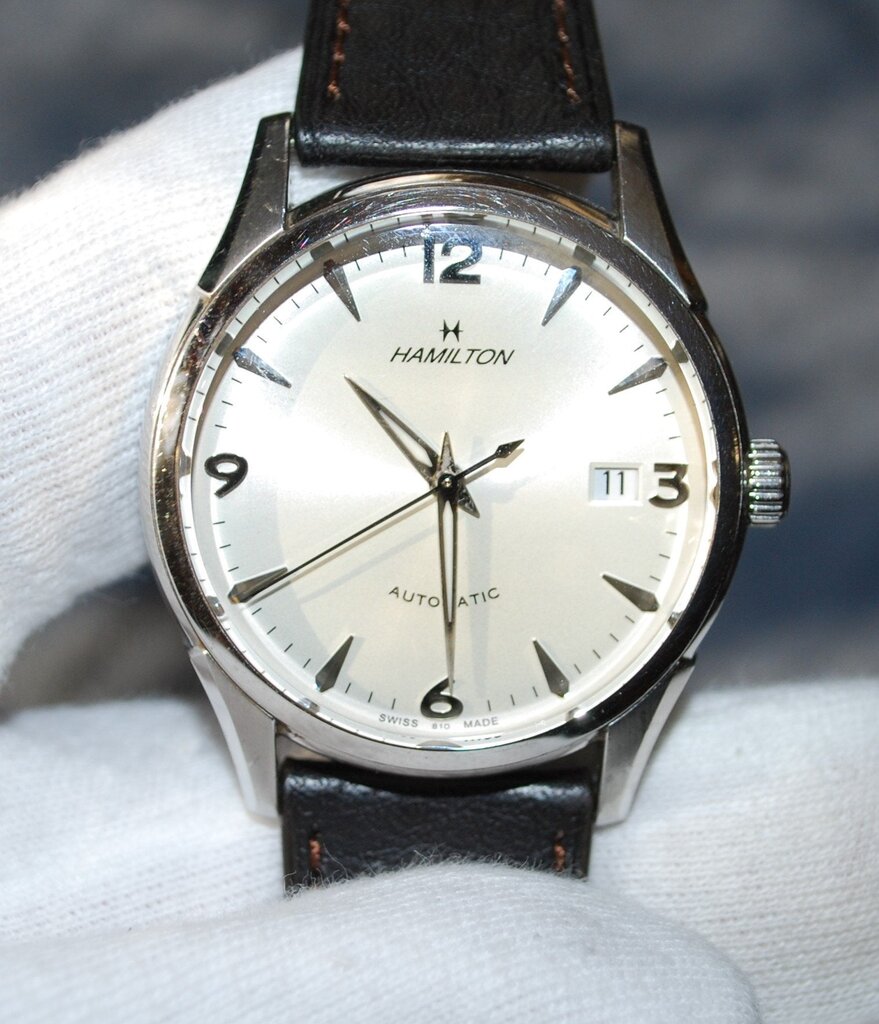
Remember the Hamilton Thin-O-Matic that I mentioned in the blog post to Ken?
Pic from
https://www.mywatchmart.comIt's available in both 38mm and 42mm. Now, if you're a big guy (either tall or wide) with a wrist measuring over 7.75 inches in diameter, then get the 42mm model. It'll look more balanced compared to the rest of you. If you're wrist is less than 7.5 inches in diameter, you might find the 38mm model a better fit. This is purely just my opinion, but one thing to bear in mind is this-what you should avoid is the overhang that may occur from wearing too large a watch. This is where the lugs (those horns that extend beyond the case to attach to the strap or bracelet) stick out past the edge of your wrist. Look at the watch on your wrist. Does it sit nicely in the middle? Can you still see some skin beyond where the lugs end? If so, then the watch is the right fit for you. Simple as that.
Now, I'm going to go against virtually everything I've just said about wristwatch size. I have wrists that measure 6.5 inches. I also have one 44mm wristwatch. Here's how it looks on my wrist, photo taken from my review;

Yes, it's huge! The Hamilton Khaki Officer's mechanical. This watch does extend beyond the edge of my wrist. But that's
precisely
the look I was going for. Some big, ridiculous, military-style watch
that made me look like an action figure, batteries-sold-separately,
thank-you very much. I wanted one watch that looked like my idea of a
WWII spy's equipment.
Would I wear it everyday? Nope. But there are some days when this feels like the right watch to wear. I wouldn't recommend it as an only watch, unless, as stated above, you're a big guy, but I would say it makes a nice addition to a collection.
If you want to play it safe, then 38mm to 40mm would be the way to go. If your build leans towards tall and thin (Dwayne F, I'm looking in your direction...even though we've never met), then this would be a good size to go for. That being the case, nearly every brand, whether Swiss, Japanese, German or otherwise, makes watches in this sizing.
However, the real decider will occur when you've got the watch on your wrist in the store. This will be the best way to determine which size suits you best and which size you're most comfortable with.
Strap or Bracelet?
This will be personal preference, but if you're in doubt, then go for the metal bracelet. You can always get the leather strap later on and it will be a cheaper option in most cases. Of course, a leather trap will dress the watch up a little more, to be sure, but it also wears out over time. Generally, you should expect to get about one-and-a-half to three years of wear out of a leather strap, depending on climate and water immersion. If you perspire a lot, the salt and alkaline properties in your sweat will chew through the stitching on a leather strap within a year or so. Now, I don't put the brand's genuine leather straps on my watches because you generally tend to pay a premium for Original Equipment Manufacture (OEM) straps. An alligator strap from Omega will set me back around $450 bucks. I can get a nice vintage Omega watch for that kind of money. Besides, I don't like to think that some poor alligator took a bullet to the head just so I could wear a strap made from its hide. And no, I don't have the same problem with cattle. Yet.
Battery or Mechanical?
Perhaps the biggest difference between what a watch will give you and what it won't may depend on whether you opt for a battery-powered (quartz) watch or a mechanical one.
Mechanical watches will usually be automatic, whereby there is a rotor inside that is attached to the mainspring and it is this which powers the watch whenever the rotor spins on its central pivot through movement of the wearer's arm, or hand-wound, where the mainspring needs to contract as a result of being wound by hand.
Quartz watches have a quartz crystal housed within and a battery to keep it all running. Now, here's the irony- a sixty-dollar quartz-powered Swatch will probably keep more accurate time than an eight-thousand dollar Rolex. However, the Rolex will be worn by your grand-son while the Swatch will have corroded in a land-fill somewhere. Why, then, do people buy mechanical watches if a cheap, battery operated watch is more accurate? For the same reason that many of you reading this are into typewriters, I suppose. It's to do with the machinery, craftsmanship and history that's involved in the manufacture of a mechanical watch.
A mechanical watch will also require a little more 'care and feeding' than a quartz one. Due to the fact that they contain a myriad of moving parts and there are tiny dabs of oil lubricating these parts, mechanical watches, like any other machine, need maintenance. Ideally, a mechanical watch should be serviced every three to five years. If, however, you reach the five-year mark and the watch is still performing as it should, you could stretch the service interval to six, or sometimes, even seven years. Although, the longer you leave it, the more work that will be required. So, as a rule, five years should be the maximum, especially if the watch is immersed in water often.
Quartz watches have far, far fewer moving parts. Generally, the battery will last about 2 to 3 years before it needs replacing. The battery that is installed at the factory, when the watch is being assembled, tends to be a heavy-duty cell, designed to keep the watch running while it sits at the factory, then at the distributors, then in a store display before somebody comes along to purchase it. As for actual servicing, quartz watches can tend to go anywhere from seven to twelve, even fifteen years before requiring any attention beyond a battery and seals change.
All well and good, but if you get too attached to your quartz watch, I can't guarantee that you'll still be wearing it 30 years from now. During my time selling watches, I saw more 50 year-old mechanical watches repaired successfully than I did 20 year-old quartz watches. It seemed that a lot of brands just don't hold or manufacture parts for quartz watches for as long as they do mechanical parts. I have a mid-Fifties hand-wound Omega Seamaster that needs a lot of TLC to get it looking and working properly and I know that I could send it back to Omega HQ in Switzerland and it would come back looking and working like a brand new watch. Along with a hefty overhaul bill. Still, cost aside, it can be done.
Perhaps things will change as the years roll by, but, at this point in time, I don't see many brands holding a vast inventory of parts for their quartz models of the past.
So, if it's accuracy and trouble-free maintenance that you're after, then go quartz. If you're wanting longevity and are willing to pay for the upkeep of a tiny 40mm machine strapped to your wrist, then get a mechanical watch.
New or Vintage?
Ahh, this can get interesting. This requires a little homework. This is pretty much the same as buying a car from the 1950s or '60s, with all that goes with restoration and performance. It is becoming increasingly harder to find a 50 year old watch in pristine condition for a reasonable amount of money. I got lucky ten years ago when I bought a circa 1962 Omega Seamaster for $350 that had no pitting on the dial (which meant that it had not ever been exposed to water) and had a movement in it that was in great condition. I could sell it tomorrow and double my money easily, but I'd never find one like it again.

In saying that, there are some nice vintage watches that could be had for a few hundred dollars, especially if you look at brands like Tissot, Cyma, Enicar or Hamilton, for example. These were produced in vast quantities and are easily found on eBay and other second-hand watch dealer websites. Most of them will hover in size between 32mm (too small, trust me) and 37mm, with a majority of them sitting at 34mm or 35mm. Most watch-makers over the age of sixty would have cut their teeth on these watches. Oh, that's another thing- aside from whether or not parts are still available for these old watches, you should also determine if you have access to a decent watchmaker. Sure, you can always send these watches back to the brand's headquarters for repair (provided the brand still exists), but you'll find most competent watchmakers will perform the work for much less. And, most competent watchmakers will be able to source parts too, even if they have to modify parts from other movements. There aren't as many watchmakers around as there used to be. Seventy percent of Switzerland's watchmakers retired in the 1970s and that number has never been refilled. Still, the Swiss swatch industry is a healthy one and there is a new crop of repairers coming along as time passes.
You could, as notagain has done, dip a toe in the second-hand watch waters and get yourself something nice that was produced by one of the more obscure Swiss manufacturers.
Have I Forgotten Anything?
This post was really meant to cover what designs to look for when looking for a dress-style watch, but it has become more of a primer on purchasing
any kind of watch. While I still plan to write something about dive watches and chronographs, I don't want to double-up on information and repeat myself. However, there are a few elements which can vary in the design or execution of the watches above. Most of the models pictured have a strip of SuperLuminova on the hands, designed to be visible in the dark. Is this a deciding factor for you when choosing this type of wristwatch?
Another thing to consider is thickness of the case. A hand-wound watch will usually have a thinner case than an automatic one. The rotor which winds the movement inside an auto has to take up some space inside the case. This can put some people off. I don't know why exactly, since it doesn't make the case thick to any great degree. The watch I'm wearing right now measures about 10mm thick, which is about standard for a dress watch.
And then, a quartz watch will be thinner still, due to the lack of parts required. So, if you want something super-thin without paying a premium, consider a quartz watch instead.
Regarding robustness, I used to get a few customers saying things like: "Ahh, I'm hard on watches, I trash them."
Well, you wouldn't trash your car and you wouldn't purposely trash the arm that your watch is strapped to, so exercise a little care. Modern watches have very good shock-protection and can take quite a lot of jarring and abuse, but if a watch falls from your bathroom basin onto a tiled floor, the impact
may just knock some internal part out of alignment, causing the watch to stop working. Dents and scratches to the external parts can be polished out, as seen in the case restoration post I wrote a few weeks ago, and internal damage can be repaired as well, but, while accidents
do happen, you can prolong the running life of your watch by treating it with a little care.
Timekeeping-wise, quartz watches will run up to a couple of minutes fast or slow per year, unless exposed to high extremes in temperature.
Mechanical watches may vary anywhere from five to 30 seconds fast or slow per day. Yes, you read it right. It's a large range, and there are numerous factors that will determine or affect the timekeeping on a mechanical watch. I'll try to be brief;
Many modern mechanical watches are set at the factory to run five to ten seconds fast or slow per day. This is considered acceptable. If you want better accuracy than that, then look at watches that are Chronometer-Rated. Any watch company can send their movements to a Swiss government-owned organisation that tests the timekeeping of these movements over fifteen days. They are tested under three different temperatures and five different positions. Large variances in temperature can affect a mechanical movement. More importantly, however, is gravity. The position of a wristwatch can determine how fast or slow it will run at any given time. This is of no concern when the watch is on your wrist, since your arm doesn't stay in one position for too long. A mechanical watch will speed up or slow down when it's off your wrist overnight while you sleep. And even then, the position that you put it down on your bedside table may cause the watch to run faster or slower. Now, I'm not talking a lot of time, here. I'm talking perhaps a few seconds. Laying the watch down flat, with the dial facing up, may cause the watch to drop 2 seconds overnight. Laying it down sideways, with the crown pointing up, may make it pick up four seconds. And so on. Some collectors will draw up a spreadsheet on Excel and 'plot' the timekeeping of their watches in different positions over the course of a week or two to find out which positions cause the watch to run fast and which positions cause the watch to run slow. Once they've got all the data collected, they can then manipulate the accuracy of their watch each day, depending on how they put it down the night before.
Now, if your watch is Chronometer-Rated, this means that the time has been adjusted while the watch was placed in five different positions. What this does is get the timekeeping as accurate as it can be for a mechanical movement. If the movement passes the chronometer testing at the government-run institute, it is then issued with a certificate to verify that the movement is indeed "Chronometer Certified". To gain this certificate, the movement is permitted to lose four seconds a day, and gain as much as six seconds a day. If it falls within this range, it will then be issued the certificate. And this is as accurate as a mechanical watch can get.
Most of the lower-priced Seiko automatics will vary by as much as 30 seconds a day. This is stated in the owner's manuals. However, your basic, garden-variety Seiko Auto is almost bomb-proof and will run for a decade or more before it needs servicing.
Price
Modern wristwatches are still produced in much the same way now as they were seventy or eighty years ago- by hand. Obviously, given the size of these watch movements and the number of parts involved, it's highly specialised work and this is factored into the price. Take the dials, for example. Each of the hour markers are applied by a steady hand, after the dial has been polished, by hand. Tiny screws in the movements are tightened by master watchmakers who know that an extra eighth of a turn will cause the mechanism to stop working altogether. And once the movement is complete, it must undergo a barrage of tests for shock resistance and accuracy.
Marketing a brand in this competitive industry also adds to the overall cost for the consumer. Whereas I used to struggle to find a wristwatch ad in magazines ten years ago, nowadays I have George Clooney as an Omega Brand Ambassador and Leonardo Di Caprio doing the same for TAG Heuer, plus any number of other brands showing full-page shots of their products.
A brand that produces an in-house movement will charge more for its watch than a company that outsources its movements from an independent movement manufacturer.
And, of course, inflation itself has raised prices over the years. And the brands also position themselves higher up in the hierarchy.
Any way you cut it, these are expensive items, whether you spend five hundred dollars or five thousand dollars. When all is said and done, as with anything, buy the best watch you can afford and one that suits your tastes, your lifestyle and your expectations.
A dress watch like the ones shown above seem to be the best sort of watch because they are an Everyman's wristwatch. If you go for something with decent water-resistance, then you have a watch that's ready for anything. The kind of watch that can't be pigeon-holed into any one true category (despite my calling them a dress watch) and can be worn anytime and anywhere.
Obviously, don't take anything I say as gospel. I've probably forgotten more about wristwatches than I've remembered. And I'm sure that a watchmaker would find holes in much of my technical info. So if you care to know more about what I've written, there's a wealth of information on the web. Also, you can always ask a watchmaker about anything I've mentioned here.
In the end, a decent wristwatch is a nice and practical item to have. And as I used to say to customers: "Done properly, you only have to do it once in your life. Like marriage."
Thanks for reading!






 Picture courtesy of www.hypebeast.com


