Alright, in an effort to reduce the spaces between posts, I've just posted the previous one and jumped right in to beginning this next one.
I started this post on Tuesday, November 7th. Melbourne Cup Day. I didn't place any bets. I gave up on it a few years ago when a horse was being led back to the stables after the race and some idiot in the crowd waved a flag as it went by. This spooked the horse and it reared up and caught a leg on the railings between the track and the crowd.
It injured itself so badly that it had to be put down later that afternoon.
So no, I don't consider it 'the sport of kings' anymore.
The Trip
I mentioned in my last post that my wife and I were feeling a little burnt-out and maybe a short trip might be a good idea. Last holiday we had was back in March 2019, when things were simpler. Nobody was hand-sanitising or wearing masks on public transport. There were no 8:00pm curfews or lock-downs of the entire state. The elderly were not being admitted to hospital with persistent coughs, never to return home again.
Travel bans had eased up back to pre-Covid levels. And we needed a short break from our hectic work schedules.
We decided a six-night stay in Ho Chi Minh City/Saigon would be a good idea. No major plans for sight-seeing. This would be a cruisy holiday where we would take things easy, get massages every day, and get around at a gentler pace. I arranged it through a travel agent in the city and the trip was booked for the first week of October.
And, me being me, I spent some time deciding on which wristwatch I would be taking with me.
I've had this solar-powered Citizen Eco-Drive Nighthawk for about five years and I've usually worn it for those occasions or purposes where it might risk getting knocked around a little. Handyman stuff around the house, bike rides, etc. This watch was what collectors refer to as a 'beater'. A watch that you'd wear when you don't want to risk damaging something more expensive or treasured.
Because I hadn't worn this watch much in recent years, I decided to move it along and promptly sold it on eBay for about $35 dollars more than what I paid for it.
A few months earlier, I had purchased a Seiko Prospex Solar Diver 200m (Ref. SNE585P) from a local jewellery chain because I liked the idea of a solar-powered set-and-forget quartz wristwatch, which would take over the beater duties of the Citizen Nighthawk. This would be the watch that I'd take with me, along with the Longines Expedition watch that I got back in 2011. I figured I might as well take something that was a little more dressy, for dinners out while we were away.
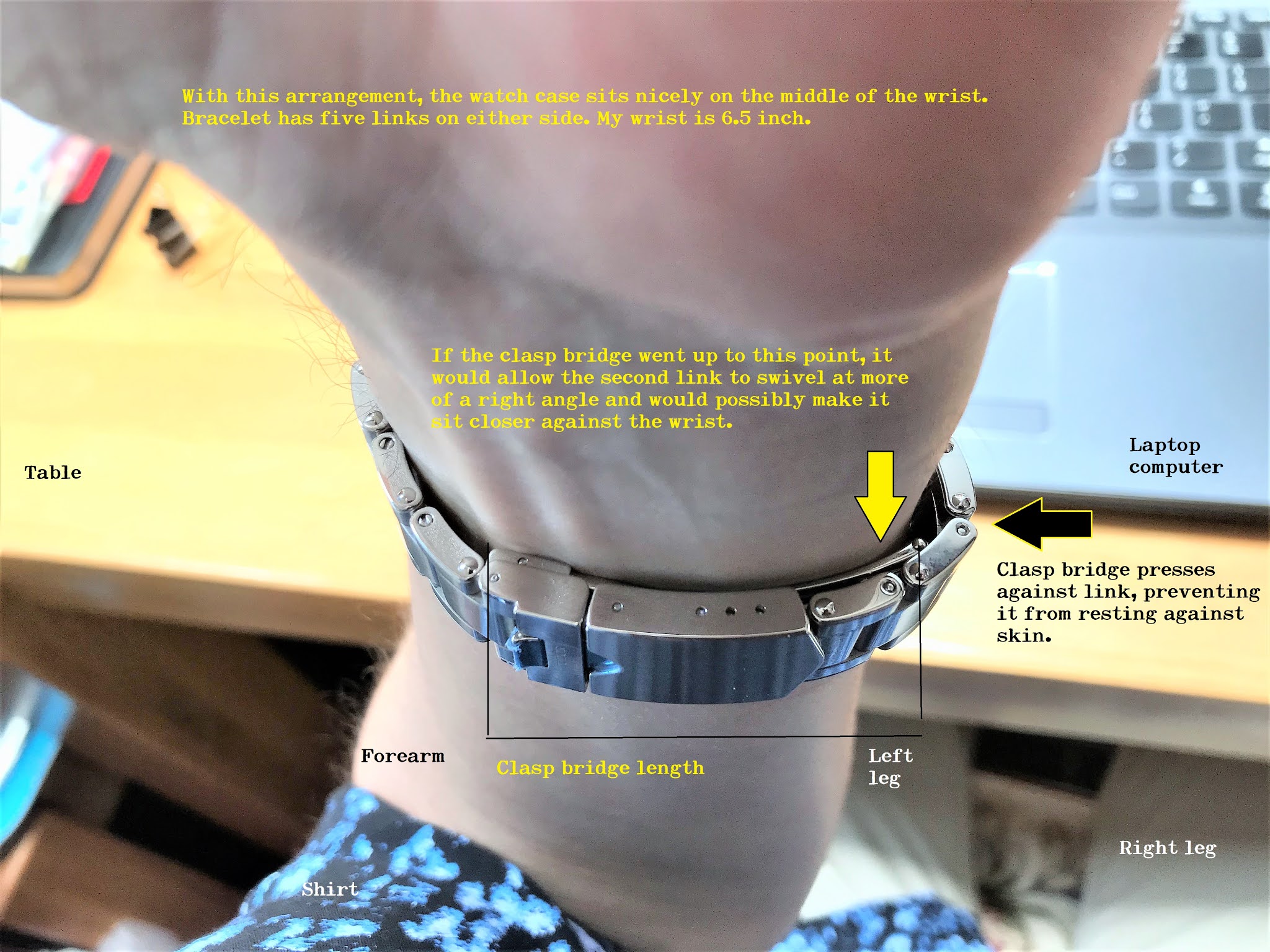
Excuse the crappy photo. I adjusted the bracelet on the Seiko watch, but I wasn't entirely happy with how secure the links would be, so I switched it over to a rubber strap. That way, I could also adjust the fit of the watch throughout the day if my wrist swelled up a little in the heat during the trip.
So, wristwatch(es) sorted. Next up, some reading material. I brought along a copy of a Mick Herron stand-alone novel titled Nobody Walks. This book is not part of his Slough House series (see previous post), but it does contain some characters from that series. In the end, I didn't end up getting any reading done.
I had also brought along a notebook, with the view to writing a bit of a travel journal while I was away. I did do some writing - with mixed results - but I found that whenever I had the time to sit and write, I didn't really feel in the mood for it.
My wife, meanwhile, had brought along some study notes that she planned to read and collate for an assignment, as part of her Master's Degree, which is in its final stages.
All set. So here below is the transcription of my half-assed travel journal. For the sake of giving it a jaded ex-pat washed-up journalist vibe, I'll switch to Courier font. In Italics.
And, with the benefit of hindsight, I'll probably add a little more than what I wrote at the time.
Yes, I'm sure it's cheating.
Monday October 2nd
The drive out to Melbourne Airport was calm and quiet. Our flight was booked for 11:30am departure. Our driver arrived on our doorstep at 8:00am. We used a limousine service rather than a cab. This costs about forty bucks more than a SilverTop, but you get a spacious car and the driver helps with your bags. We were travelling in a late model Mercedes-Benz and it was a very smooth ride. Looking back, I think next trip we'll probably just take a train into the city and then catch the SkyBus to the airport from there. It'll be way cheaper. And we can manage our bags ourselves.
Got to the Departures Terminal with plenty of time to spare. We'd already done the online check-in the night before, so we proceeded to the shorter queue and checked our suitcases in, once again thinking that we may have over-packed.
Mrs. Teeritz and I discussed ways of being slightly more savvy travellers while we sat in the airport's Brunetti Cafe with a couple of lattés. We haven't travelled enough to get good at it.
By the way, excuse my handwriting. I'm writing this at 39,000ft. Destination is about 4,000 mls/ 6,400 km
Time to Destination - 7hrs, 50 mins
ETA - 3:36pm
4 hrs behind Oz
- Flight a little tiring. Feeling sleepy.
I have to admit, I don't fly well. It doesn't make me nervous, but it does tend to knock me around a little. My tinnitus flares up a little, my ears block up due to the cabin pressure, perhaps. By the sixth hour, my head began to pound a little. I popped a couple of Panadol and counted down the remaining two hours, as I unwrapped a couple of sticks of gum to deal with the blocked ears prior to landing at Tan Son Nhat Airport in Ho Chi Minh City.
After getting our bags from the carousel, we got into the queue for immigration/arrivals and we were soon dealt with by an officious and very competent clerk who stamped the dog-eared page in my passport. I had purposely put the slight fold in the top corner of the page. It already had the stamps from our previous visit back in 2019 and, for the sake of continuity, I was hoping he'd stamp the same page. Which he did. Cool!
Stepped out of the airport terminal building into the warm Saigon air. It was overcast.
We caught a cab to the hotel* and I was again reminded and amazed by the way traffic operates in Saigon. Probably 70 or 80% of it is made up of motor scooters and it's an intricate ballet of two and four-wheeled vehicles which negotiate around each other at any given time. Our cab driver relied heavily on his horn, as he closed up gaps in traffic before too many scooters zipped up ahead to block his path. Red lights at intersections are a suggestion, it seems, as some scooter riders check left and right before stealing their way across, with little regard for approaching cars which have the right of way. The cars slow down to let them pass, anyway. You hear regular short beeps from scooter and car horns, but I have to say I didn't hear the screeching of tyres or the sound of crunching metal at all during our time there.
Checked-in to the hotel at around 5:30pm. We were taken to our room and we sat down on the bed and made loose plans for the rest of the evening. We decided, as per usual, to head out and go for a walk to get our bearings. And to look for an ATM teller machine for some funds.
The one thing that took us a bit of getting used to again was the exchange rate. One Vietnamese Dong doesn't translate into any meaningful amount in Australian dollars.
Basically, 10,000 Vietnamese Dong (VND) equals about $0.65 Aussie cents. So I had to jump onto XE.com more often than I wanted to. Since I carry pen and paper, I quickly jotted down a handy reference;
VND AUD
1,000,000 $65.oo
500,000 $32.50
400,000 $26.oo
300,000 $19.50
200,000 $13.oo
100,000 $ 6.50
50,000 $ 3.25
20,000 $ 1.30
10,000 $ -.65
I didn't end up using the money clip, opting instead for a small leather RFID blocking credit card holder which contained my bank card, AMEX card, and whatever cash I might carry. This wallet was small enough to fit into my front pockets. I did feel weird carrying three million Dong, even though it only equated to about $195.00 AUD.
We got back from our walk and decided to hit the small bar on the 1st floor of our hotel. After a quick look around, we took a seat at a low table. This would be where my wife would do most of her study while we were away. The waitress brought over a cocktail menu. I had a quick glance through it and didn't see the drink that I wanted. No big deal. I'd just order it anyway.
She came back to us about five minutes later and I asked for an Americano cocktail, which is basically one measure of Campari, one of sweet red vermouth, and then topped up with soda water, in a glass over ice. The waitress had a little trouble understanding my order. So, I ended up ordering a Negroni instead, which was listed on the menu. I don't mind Negronis, but it's a very on-trend drink at the moment and I like to take the road less travelled.
It arrived about ten minutes later. Not bad, but I couldn't help thinking that they may have used Aperol instead of Campari because it had a light orange hue to it rather than a darker blood-orange colouring.
Later in the evening, we went up to the 24th floor where the roof-top bar and pool were located. The floor below was where the gym and day spa were situated. It was good to find the spa, because we had planned to get daily massages during this trip.
We resolved to make a booking next day. We got to the bar and I ordered a Gin & Tonic. My wife doesn't drink. The air was warm as we sat there looking out at the cityscape under the night sky. Saigon is known for a plethora of roof-top bars and many of the hotels have pools on their roof-tops. That way, lower floors can be dedicated to rooms.
After this, we went for another walk down the road from the hotel and found a Runam Café on a nearby corner. We visited one of these cafés the last time we were here. It's a small chain, but they make excellent coffee. Truth be told, you really cannot get a bad cup of coffee in Saigon. Every place we visited made a great cup.
Tuesday October 3rd
Got up around six am. My body clock is in business for itself. Went down to breakfast buffet. One thing that we began doing about ten years ago whenever we travel- always see if a buffet breakfast is included with the hotel room rate. You can sometimes eat a big breakfast, since there's so much to choose from, and virtually forego having lunch later in the day.
My wife ordered a latté and it arrived soon after. It was very milky. We suspect that the coffee was Nespresso. It had no kick to it. No major drama. This city has more coffee places than Melbourne. A lot more.
My wife likes her first cup of the day to be strong. I have to agree. Your first coffee should be an ignition key that wakes you up.
Headed out for a walk after breakfast and we ended up at a café called Shin Heritage, which we visited a few times when we we last in Ho Chi Minh City. We had a couple of coffees, to make up for the lacklustre ones that we'd had at breakfast. After that, we kept on walking and soon got lost. Again, no major drama. Stopped in a another Runam Café and checked Google Maps on our phones**. Turns out we were 300 metres away from our hotel. We had a couple of cool drinks at this café. I had a Strawberry and Blueberry smoothie and my wife had a Lemon and Mint cordial.
Later in the afternoon, we headed up to the hotel's day spa for a massage. It was in a quiet, dimly-lit room. I opted for the one-hour full-body massage and felt like jelly by the end of it.
We had the same the following day.
As I said earlier, this travel journal of mine was half-assed. A couple of days into the trip and I wasn't really keeping tabs on what we did. This probably had more to do with the fact that we had no real plans for this holiday besides walking around the neighbourhood and taking things easy wherever possible. As such, the journal and our photo-taking took a back-seat to us just being there with no definite aims set.
One day three, we headed out. There are a couple of things that are abundant in Saigon. Cafés and roof-top bars, as already mentioned, and day spas. These spas all vary slightly in terms of services that they offer. Some do massage only, others offer manicures and skin treatments. Most of them have doorways that are situated on street level and you'll usually see two or three ladies sitting on stools outside trying to drum up business, with a casual "Hello, Madame" to my wife as we walk by.
One such place had an entrance hall with a scooter parked inside it. Two ladies were sitting outside and they greeted us as we walked by. We stopped to look at the pamphlet that they offered us. Foot Massage Acupressure, Facial Reflexology + Head Massage, Manicure Polish, Foot Massage with Paraffin, Special Acne Treatment(!), Pregnancy Massage(!!??), the list went on. And on page three, A Body Relaxing Oil Massage for three hundred and fifty thousand Dong, which worked out to about $21.00AUD.
We booked two of those for later in the afternoon. Twenty-one bucks was better than the sixty that we had paid at the hotel's day spa. And how bad could it be?
Later in the afternoon, we walked over to this day spa and were ushered up two flights of stairs in this wonderful old building to a group of small rooms. We pointed to the 60 minute Body Relaxing Oil Massage on the list of options and then were led to two tables in another room where we disrobed down to our underwear. Always leave your underwear on, thrill-seekers. Removing them sends a completely different message. That was not what we were after. And I got the impression that this was not that kind of place, anyway.
As
regular readers may recall, I had bunion surgery on both feet back in
September last year. Then, in March this year, I fractured a
metatarsal bone in my left foot and have been feeling some pain in it
ever since, due to the fact that I walked around with this fracture for
ten days or so before getting it attended to properly. As a result, I
think the fracture didn't heal properly.
As a result, I didn't want my feet touched during the massage, so I showed my masseuse a Google translated sentence that I had prepared before we arrived. In English, it was; "I had both feet operated on last year. Please do not touch my feet." She read the Vietnamese translation and giggled. She had very limited English, so we explained it to the older masseuse - who spoke better English - and she explained it to my one.
Later that night, I re-translated the Vietnamese sentence back into English and it read; "I am a magician. I had to send my brothers to another dimension."
Once we stopped laughing, I re-wrote the Vietnamese sentence in Google Translate one word at a time and got vastly different English translations each time.
Vietnamese has numerous symbols above various letters. I had a feeling they would have different meanings. Back in my hospitality days, a customer told me that the Vietnamese word 'toi' could be pronounced five or six different ways, each with a different meaning.
A quick question on Google yielded this answer;
Vietnamese has an extensive number of letters with diacritical marks to make tonal distinctions.
There you have it. That explained the giggling. She must've thought I was crazy.
Anyway, I once read that when you're getting a massage the idea is to relax and just focus on the area that is being worked on. I lay on the table, with my face in the cut-out and began to relax as my masseuse worked on the back of my neck and shoulders. My wife was on the table alongside mine and I heard her masseuse say; "You are very strong." Lady Teeritz does light workouts throughout the week with the weight set that we have out in the car-port. She has sometimes recounted to me the story about actress Linda Hamilton who, when she began training prior to filming "Terminator 2: Judgment Day" in 1991, stated that she wanted to get 'a better back than Madonna's'.
By the end of it, I could have fallen asleep there and then. I felt like jelly. My eyes were bleary as I gingerly got off the table and got dressed. My wife felt the same. We had found our preferred place for massages for the remainder of our trip.
During our time in Saigon, my left foot didn't really hurt all that much. Was it the warm weather? I also thought that the high humidity in Vietnam might affect my asthma, but I found no issues with my breathing while we were there. My wife said her eyes didn't feel as dry as they do back home. Her hair did go a little frizzy, though. Not something that I myself had to worry about.
We didn't take many photos this time around. We figured we'd take a holiday from doing so. Therefore, I'll just include a few pics from the time we were here back in 2019. For atmosphere.
I wanted to visit the Hotel Continental again. This is where author Graham Greene stayed, in Room 214 while writing The Quiet American in the early 1950s. Maybe we'd have a drink at their Bar Du Jardin. This time around, the bar was closed to the public. So we headed to the gift shop, which was also closed, and I asked at the reception desk if they still sold the coffee mugs with their logo on it. I had bought one the last time we visited.
They informed me that these were no longer available. Ahh well...
Here's a shot of the Opera House, a grand old building located near the Continental Hotel. This time around, on the evening we walked by, there was a large crowd gathering outside waiting to be ushered in for some performance that night. A newly-wed couple stood on the steps to have some photos taken, while other random visitors took selfies nearby, with the facade of the Opera House in the background.
At some point during this trip, two things happened to me; my stomach began feeling a little dodgy and I got some kind of skin rash on my forearms and neck.
My wife and I retraced events, to see if we could determine the cause. We narrowed it down to the day before. We had been walking around the city streets and by around 2:00pm, I was feeling quite hungry, to the point where I was a little light-headed. We had yet to try any of the street food vendors and as we stood on a street corner looking for some place to eat, a young man approached with a laminated menu and I took a quick look at it. Some type of barbecued pork on a skewer. Yep, that would do. My wife's appetite in hot weather tends to diminish, but I was quite ravenous by now. So, the young man led us upstairs to a large dining room and we took a seat at a large table. The place was empty. Was that a sign? I ordered two of the pork skewers and a lemonade. My wife didn't have anything.
The skewers arrived soon after I placed the order. They were nice. "Are they hot?", my wife asked.
"Just above warm", was my reply.
"Be careful, T", she added.
Once I was done, an older lady brought me the bill and a refresher towel in a sealed sachet. I was feeling the humidity, so I used this towel to wipe down my forearms and the back of my neck to cool off a little.
Next morning, I felt a little queasy at breakfast and just had some buttered toast and fruit. Looking down at my arms, I noticed a reddish rash and it was slightly itchy. My wife saw that the back and sides of my neck looked pinkish and goose-bumpy. Playing detectives, we reasoned that maybe the warm pork might not have been a good idea and the refresher towel was probably not free of parabens, which I'm allergic to.
The street food in Vietnam is generally safe to eat, as long as it's hot. Another tip would be to eat from a street vendor where the locals are eating. I'll know for next time.
So, my appetite took a nose-dive for the rest of the trip.
We had our massage in the afternoon and while my masseuse was working on my shoulders, I felt her pause for a moment and then felt a finger drag slowly along the back of my neck. She then left the room. Was she getting an axe?
She returned a few moments later and a felt a cream being applied to my neck and rubbed in. Within a couple of minutes, the itchiness subsided.
Friday October 6th
Haven't really kept a travel journal this trip. Too tired or busy. That's okay, though. This holiday was all about taking things easy. Got back onto cigarettes, with very mixed results. I said to my wife a while ago that I'd only smoke when I travel. Silly idea. Takes too long to get off them once I return home. My handwriting's crap, by the way.
Needless to say, a few ugly Australians staying in town, so Mrs Teeritz and I are being our usual selves by counteracting their poor behaviour. We had a quick lunch at My Bahn Mi, a small place that specialises in these pork or chicken filled bread rolls with lettuce and seasoning. A couple came in and sat a few tables away from us. The male was a large, heavy-set guy with close-cropped blonde hair. He ordered a beer. A few minutes later, the waitress brought over a beer bottle in one hand and a frosted tall glass in the other. As she attempted to place these items on the table in front of him, this fellow snatched the bottle from her hand while pushing her other forearm away, indicating that he didn't want the glass. He then polished off half the bottle in one swig and said to her; "Haven't you got bigger bottles?"
The bottle in his hand was a standard 355ml. Very poor behaviour, buddy. Very poor.
I don't know why it's so hard for some people to remember that they are a guest in a foreign country and should, therefore, present the best of themselves.
Then again, maybe that WAS the best of him.
My appetite was a little better, so I figured I could eat a chicken Bahn Mi without any issues.
For dinner, we went to the Runam Café near our hotel. My wife ordered a salad and I just ordered some fries. Her plate arrived about fifteen minutes later. Another ten minutes went by. Then another five. My wife called the waitress over and we mentioned that we had ordered some fries also. Shortly afterwards, the manager came over to offer his profuse apologies for the delay. We said it was fine, no problem. Being a hospitality industry veteran, I know that these things happen. We assured him that it was no major drama. He apologised again before retreating.
My fries arrived about five minutes later. All good. Afterwards, we ordered coffees. A latté for my wife and an affogato for me.
'Affogato' means 'drowned' in Italian. You basically take an espresso coffee and add a small scoop of vanilla ice cream to it. Drowning it. The ice cream melts, resulting in a creamy golden brown coffee.
They brought the coffees over. My affogato had a small scoop of vanilla ice cream in it, a little smaller than a golf ball. Then the waitress put another small bowl down in front of me. It had seven or eight more scoops of vanilla in it, with some maple syrup drizzled over it.
"You sure you'll manage?", my wife asked me with a raised eyebrow as I dipped my teaspoon into the ice cream.
Saturday October 7th
Our final night in Saigon. My handwriting is on holiday also, it seems.
Today was good. 90 minute massage, light lunch and then to the Rex Hotel for a beer at their roof-top bar. Hot day and not much cooler while we sat there talking about future travel plans. Slow walk back to the hotel. Mrs Teeritz has been the best travel companion.
Wonder if I'll try an egg coffee before we leave? My stomach has been a little stand-offish this trip. I may have lost a kilo.
We had no firm daily plans during our time in Ho Chi Minh City/Saigon this time around. We had gotten a little burnt-out by our respective jobs and this trip was all about taking a breather and recharging our batteries.
This trip pretty much did that for us.
*We caught a cab to the hotel...
The driver took us for a ride. Really took us for a ride. I was watching the meter while he drove. Towards the end of the journey, it was showing around 2 million Vietnamese Dong, which worked out to about $125AUD. Ouch!
Feeling head-achey still from the flight, and reasoning that the Aussie limo to Melbourne Airport back home cost a little more, I figured this was a standard cab fare here in Saigon. First mistake. I should have remembered that a lot of things in Saigon are cheaper than back home.
As we stepped out of Tan Son Nhat Airport, a young lady in corporate black trousers and crisp white shirt asked us if we wanted a taxi. I replied "Yes, a Vinasun taxi, please". Vinasun is one of the few authorised cab companies in Vietnam. She led us over to a cab rank and a driver quickly helped us with our bags.
"Does the cab have a meter?'', my wife asked me under her breath.
"You have a meter?", I asked the driver as he came around and held the back passenger door open for me.
"Yes, yes, have meter", he replied as he made his way around to the driver's seat.
Second mistake - the cab didn't have the Vinasun livery across its doors.
So, after a half-hour drive - which felt longer than I remember - where he steered with one hand while checking his cell-phone with the other, we arrived at the hotel and I counted out the Vietnamese Dong that I had brought with me. This money was left-over from our previous trip in 2019. I counted it out. One million eight hundred thousand VND.
Not enough.
"You have Australian dollar?", he asked, a little too hopefully. I had a hundred and ten bucks in my wallet. I handed it over to him while I asked my wife if she'd brought any AUD with her. She hadn't.
Then I remembered my mobile (cell) phone. I keep it in a leather flip-wallet and, behind the phone itself is an emergency $20 note, designed to get me a cheap lunch and coffee if I ever leave the house without my wallet. I don't do the pay-with-your-phone schtick that I see 90% of people doing these days.
I fished this folded note out from behind my phone and handed it over to him. The fare was $120AUD and I gave him $130.00; "And ten for you", I said.
Seven days later, when it was time to head home, our hotel's Concierge ordered a Vinasun taxi for us. The driver helped with our bags and got us to the airport in about 20 minutes. Then he turned to me and said; "One hundred fifty six thousand."
Had I heard him correctly? Hundred and fifty six thousand VND? That worked out to about twelve bucks AUD. I asked him again; "One hundred and fifty six? Thousand?"
"Yes, one, five, six", he replied.
I gave him about 220,000.oo VND, which covered the cab fare and left him with a four dollar tip, which seemed to make him happy. He fished our cases out of the boot (trunk) and bid us farewell.
I stood there at the terminal. My wife said; "What's up?"
I explained the cab fare.
"You're joking. Oh my God!"
"Bastard", I said, referring to the driver who took us to our hotel a week earlier. "That bastard", I repeated.
"Do you know how many meals a hundred and twenty bucks would have paid for?", my wife said, shocked. "How many massages?!", she added.
"That's it T, we're too old to be rubes like this. The bastard."
I hope that driver has ten kids to feed, and I hope they ate well that night.
So, hepcats, if you need a cab from Tan Son Nhat Airport in Saigon/Ho Chi Minh City, ALWAYS look for a Vinasun taxi.
**Stopped in a another Runam Café and checked Google Maps on our phones...
Our mobile phone provider used to be Optus. However, they had a massive data breach last year and, for me, this was the final straw. I switched over to ALDImobile, run by the German supermarket chain which opened up here in Oz about a decade ago. My wife had already defected over to them over a year ago.
Only thing was that ALDI doesn't have International Roaming from Vietnam. Strangely, though, they DO have Norway. You know, for all the Norwegians who call Australia on a heavily regular basis.
No huge drama, we thought. We would FaceTime our kids while we were away...until it dawned on us that my wife and I have iPhones and the kids switched over to Android-powered Samsung Galaxy and Google Pixel phones earlier this year.
Another travel-rookie mistake! In the end, we wound up using Instagram video calling with our daughter, just to stay in touch with the kids while we were away.
And we used free Wi-Fi wherever it was available.
Which would explain the absolute bombardment of Spam emails I've been getting since we got back from this trip. I'm laughing as I write this.
Either laugh or cry, buddy.
Laugh or cry.
Next trip, we'll get a couple of $200 dollar data cards for our phones from the Post Office and use them while we're away. A little more research required before then.
Time to become a little sharper when we travel.
That damn cab driver!
Thanks for reading!